Insomnia Isn't One Thing (And That's Why Advice Fails)
Dovy Paukstys
Founder, Komori Care
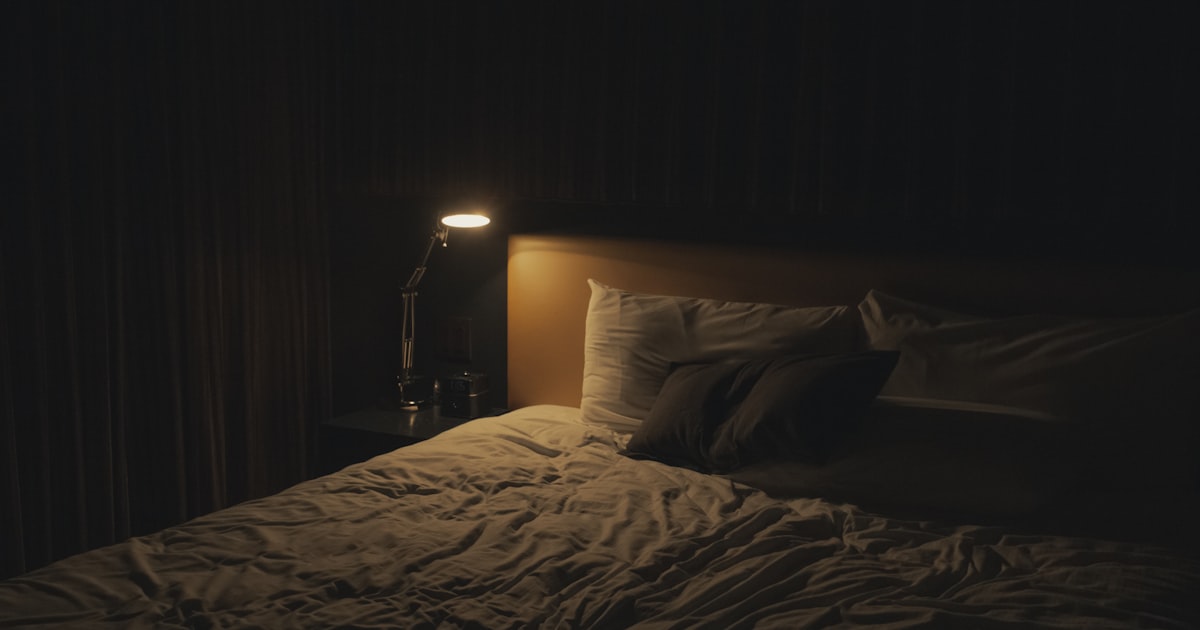
You Did All the Advice. You're Still Awake.
Cut the caffeine. Dim the lights. No screens after nine. Cool room, dark room, same bedtime every night, get up at the same time on weekends.
You did all of it. It's 1:40 a.m. and you're staring at the ceiling doing math on how many hours are left.
Here's the part almost nobody says out loud. "Insomnia" doesn't name a mechanism. It names a complaint. It's the sleep version of "chest pain." Chest pain can be a heart attack, a pulled muscle, reflux, or a panic attack. Four different problems that all produce one shared sentence.
Insomnia works the same way. Which is exactly why one-size advice fails so many people. It's aimed at an average patient who doesn't exist.
This post is educational, not diagnostic. If your sleep has been bad for months, the person who can sort out which version you have is a clinician, not a blog post.
Key Facts
- Chronic insomnia disorder means trouble sleeping 3 or more nights a week for more than 3 months, plus daytime consequences (StatPearls)
- About 30% to 36% of adults report at least one insomnia symptom; by strict diagnostic criteria it's 6% to 10% (StatPearls)
- The AASM strongly recommends multicomponent CBT-I, and separately advises clinicians not to use sleep hygiene as a standalone therapy (AASM 2021 guideline)
- A study of 2,224 people found five stable insomnia subtypes — sorted by traits and life history, not by sleep symptoms (Lancet Psychiatry, 2019)
- Insomnia with objectively short sleep looks biologically different from insomnia with normal sleep duration (Sleep Medicine Reviews, 2013)
- CBT-I improved time-to-fall-asleep by about 19 minutes and night-time wakefulness by about 26 minutes across 20 trials (Annals of Internal Medicine, 2015)
The Label Covers At Least Four Different Nights
Clinically, chronic insomnia disorder is defined by difficulty starting sleep, difficulty staying asleep, or poor sleep quality, happening at least three nights a week for more than three months, with real daytime fallout [^1]. That's a wide net.
In practice, people walk in describing one of four very different nights:
1. You can't fall asleep. Lights out at 11, still awake at 1. Body tired, brain running. Sleep latency, which just means how long it takes you to fall asleep, is the problem. Everything after that is fine.
2. You can't stay asleep. You drop off in ten minutes, then you're up at 2:30 and again at 4:15. Getting back down takes an hour each time. We've written more about why 3 a.m. wake-ups happen.
3. You wake up too early. Asleep by 11, awake at 4:20, done. Not tired enough to sleep, not rested enough to function.
4. You slept a normal amount and feel terrible anyway. The clock says seven hours. Your body says two.
Those are not four flavors of one thing. They're four different failures that happen to share a waiting room.
Same Word, Different Machinery
The research keeps finding that the label hides more than it reveals.
One useful split is by how much you actually sleep. A large body of work from Penn State separates insomnia with objectively short sleep duration from insomnia with normal sleep duration. The short-sleep version is linked with activation of the body's stress systems and a higher risk of things like high blood pressure and neurocognitive problems, and tends to run an "unremitting course." The normal-duration version shows cognitive and cortical arousal and sleep misperception, but not the same stress-system signature, and is "more likely to remit" [^2].
The authors go further and argue the two may need different treatment: the short-sleep phenotype has "primarily biological roots," while the normal-duration phenotype has "primarily psychological roots" and may respond better to psychological treatment alone [^2]. Two people, one label, two different treatment logics.
A different research group came at it from a completely different angle. In a 2019 Lancet Psychiatry study, researchers ran a data-driven analysis on 2,224 people with probable insomnia and found five subtypes — and here's the interesting part, the subtypes were not defined by sleep symptoms at all. They were defined by traits like distress level and reward sensitivity. The groupings stayed stable over an average of about 4.8 years of follow-up [^3].
Read that again. The most stable way to sort insomnia patients found in that study had nothing to do with whether they had trouble falling asleep or staying asleep.
When the Clock and the Feeling Disagree
Then there's the fourth night from that list — normal sleep, terrible feeling. It has a name.
Paradoxical insomnia, once called sleep state misperception, describes "a misperception of sleep time without objective evidence to support this perception." People underestimate how much they slept, experiencing sleep as wakefulness. In a sleep lab, the tracing looks fine: normal time to fall asleep, normal efficiency. The person reports the opposite. Estimates of how common this is among people with chronic insomnia range from about 9% to 40%, depending on how you define it [^4].
The current international classification doesn't keep paradoxical insomnia as its own diagnosis anymore. It's folded into chronic insomnia disorder [^4]. Which tells you something about the state of the field: even the classification systems are still arguing about where the lines go.
If you've ever been told "your sleep study was normal" and felt gaslit by it, this is why that experience is real and documented.
A 2026 Attempt to Map the Failure Modes
There's an interesting proposal out right now that tries to formalize all of this. In a 2026 preprint — meaning it has not been peer reviewed yet — a researcher proposes what he calls a dynamical taxonomy of insomnia [^5].
The core idea is exactly the argument in this post: "similar complaints can arise from different abnormalities in sleep regulation, state transition, state stabilization, spatial recruitment, architectural sequencing, and state perception." Instead of sorting people by symptom, it sorts by which operation in the sleep system is failing, at which stage boundary, and whether it's primary or secondary [^5].
Two honest caveats. It's a framework paper, not an experiment — the author describes it as "a phenomenological organizing model." And by his own account only the sleep-onset piece has meaningful empirical support so far; the rest is "hypothesis-generating." He also notes that a routine sleep study can't separate the underlying parameters he's describing [^5].
So: a proposal, not a finding. But it's a proposal built on a real problem.
Why Sleep Hygiene Alone Doesn't Fix It
Now the practical part.
Sleep hygiene — cool room, no caffeine, consistent schedule — is the advice everyone gets first. It's also the advice that fails most reliably, and the guidelines say so.
The American Academy of Sleep Medicine's 2021 clinical practice guideline recommends "clinicians not use sleep hygiene as a single-component therapy" for chronic insomnia in adults. That's a conditional recommendation, meaning clinicians should weigh the individual case, but the direction is clear 1.
Sleep hygiene isn't wrong. It's just not treatment. It's the equivalent of telling someone with a broken leg to wear supportive shoes.
What Actually Works, and Why It's Tailored
Cognitive behavioral therapy for insomnia (CBT-I) is the first-line treatment. Not a supplement. Not a drug. A structured behavioral program.
The AASM gives multicomponent CBT-I a strong recommendation — its highest level of endorsement 1. The American College of Physicians is equally direct: "ACP recommends that all adult patients receive cognitive behavioral therapy for insomnia (CBT-I) as the initial treatment for chronic insomnia disorder," graded strong 2.
The numbers hold up. A meta-analysis of 20 randomized trials covering 1,162 people found CBT-I improved time-to-fall-asleep by 19.03 minutes and wake-after-sleep-onset — time spent awake after first dropping off — by 26.00 minutes, with sleep efficiency up 9.91%. Total sleep time barely moved (7.61 minutes, and the confidence interval crossed zero) 3. Benefits held at follow-up, and no adverse outcomes were reported.
Notice what that pattern means. CBT-I doesn't mainly make you sleep longer. It makes the sleep you get more consolidated, and it breaks the loop where the bed becomes a place you go to fail.
And it isn't one protocol. CBT-I is a toolkit, and a clinician picks from it. The AASM guideline separately covers stimulus control, sleep restriction therapy, relaxation therapy, and brief multicomponent interventions as individual components 1. Which ones you get should depend on which night you're actually having.
| Your complaint | What it often points toward | Component that usually targets it |
|---|---|---|
| Can't fall asleep | Conditioned arousal, body clock timing | Stimulus control, relaxation |
| Can't stay asleep | Fragmentation, low sleep pressure | Sleep restriction, stimulus control |
| Wake too early | Body clock timing, low sleep drive | Timing-focused work, sleep restriction |
| Slept fine, feel awful | Sleep misperception, daytime factors | Cognitive work, re-evaluation 4 |
| Short objective sleep + high arousal | Stress-system activation | Clinician-directed; may need more than behavioral therapy 5 |
Use that as a conversation starter with a clinician, not as a self-assignment. Getting the component wrong can make things worse — sleep restriction in particular is not something to freelance.
One more thing worth saying plainly: insomnia isn't distributed evenly. A meta-analysis covering more than 1.2 million people found a risk ratio of 1.41 for women versus men, and the gap widened with age 6. If you're a woman who has been told your sleep problem is stress, that's a common and often incomplete answer.
Where Komori Fits
Let me be straight about this. Komori is not a treatment for insomnia, and it isn't a diagnostic. It's a general wellness device, it hasn't shipped, and no data from it substitutes for a clinical evaluation.
What it's being built to do is narrower and, I'd argue, more honest. Komori is a contactless system that senses from above the bed — no camera, no wearable, nothing touching you — paired with a base unit on the nightstand that handles power, Wi-Fi, and local processing. It's designed to log sleep position, movement and restlessness, bed-exit events, and room conditions like temperature, humidity, CO2, light, and noise, night after night.
Why that matters for this topic: the thing a clinician usually lacks is your ordinary nights. Not one lab night. Thirty regular ones. Whether you're leaving the bed at 3 a.m. four times a week or once a month, whether the room is 78°F when the wake-ups cluster, whether restlessness is up on the nights you feel worst. That's context, not a diagnosis, and it's the kind of thing a sleep diary is supposed to capture and usually doesn't, because nobody fills one out accurately at 4 a.m.
If you want the counter-argument to over-measuring your own sleep, we wrote about orthosomnia, which is what happens when tracking becomes the problem. And if your specific complaint is the falling-asleep half, our piece on sleep latency goes deeper on what's normal there.
The Actual Next Step
If you take one thing from this: stop looking for the tip that fixes it. The tip isn't the problem. The category is.
Go to a clinician and describe the specific night. Not "I have insomnia." Say: I fall asleep in ten minutes and wake at 2:30 and can't get back down, four nights a week, for eight months, and I'm useless by 3 p.m. That sentence points somewhere. "Insomnia" doesn't.
Then ask directly about CBT-I. It's the first-line treatment in both major guidelines, and a lot of people never get offered it. That's the conversation to have.
Footnotes
-
Edinger JD, et al. "Behavioral and psychological treatments for chronic insomnia disorder in adults: an American Academy of Sleep Medicine clinical practice guideline." Journal of Clinical Sleep Medicine, 2021. ↩ ↩2 ↩3
-
Qaseem A, Kansagara D, Forciea MA, Cooke M, Denberg TD. "Management of Chronic Insomnia Disorder in Adults: A Clinical Practice Guideline From the American College of Physicians." Annals of Internal Medicine, 2016. ↩
-
Trauer JM, Qian MY, Doyle JS, Rajaratnam SMW, Cunnington D. "Cognitive Behavioral Therapy for Chronic Insomnia: A Systematic Review and Meta-analysis." Annals of Internal Medicine, 2015;163(3):191-204. ↩
-
Haslam AX, et al. "Paradoxical Insomnia Versus Atypical Obstructive Sleep Apnea or Mixed Disorder? Case Report and Literature Review." Clinical Case Reports, 2025. ↩
-
Vgontzas AN, Fernandez-Mendoza J, Liao D, Bixler EO. "Insomnia with Objective Short Sleep Duration: the Most Biologically Severe Phenotype of the Disorder." Sleep Medicine Reviews, 2013. ↩
-
Zhang B, Wing YK. "Sex differences in insomnia: a meta-analysis." Sleep, 2006;29(1):85-93. ↩
You can choose a position at lights-out. Knowing what you held until morning is the hard part.
Komori is a contactless monitor that logs which position you slept in, through blankets, with no camera and nothing to wear. Pre-launch — join the list and we'll tell you when it ships.
Keep reading
Want to see your sleep position data?
Join the free waitlist for launch updates. Or lock in founder pricing with the Insider Pass ($49, credited toward your purchase).