Teeth Grinding at Night: What Bruxism Does to Your Sleep
Dovy Paukstys
Founder, Komori Care
Somebody Else Noticed First
Almost nobody discovers their own teeth grinding. Either the dentist looks at your molars and asks a careful question, or your partner tells you that you sound like a coffee grinder at 2am.
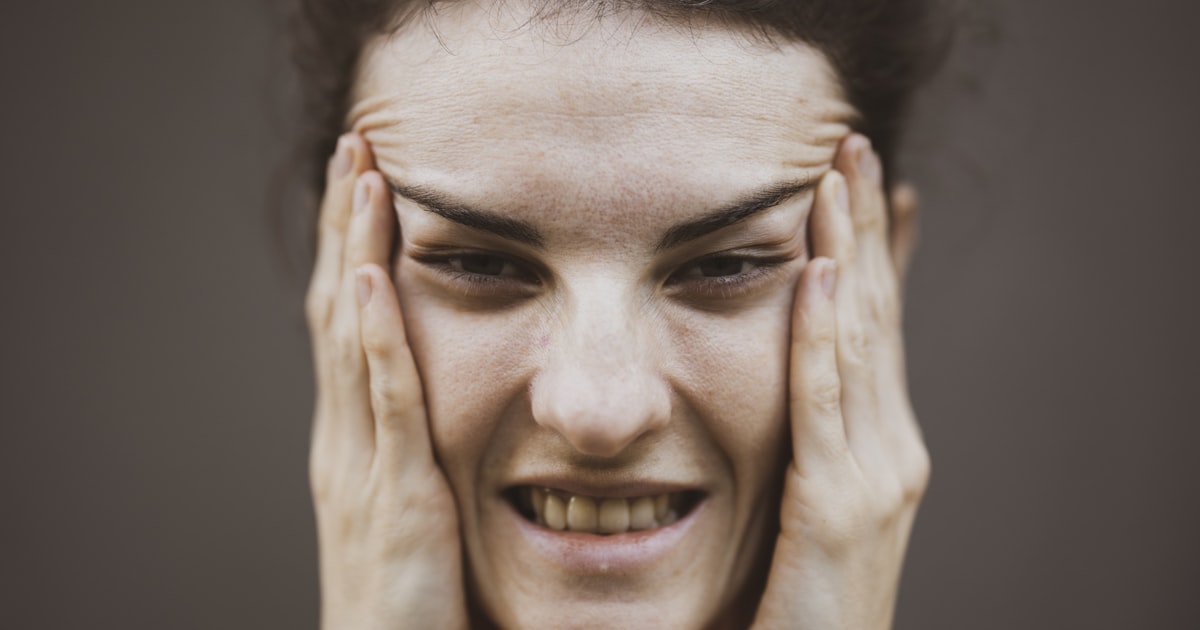
That's the strange part about sleep bruxism. Your body does it for years, loudly, and you sleep straight through it. The first evidence is usually flattened tooth surfaces, a jaw that aches on waking, or a headache parked at your temples before you've done anything to earn it.
This post covers what sleep bruxism is, where it comes from, what it costs you, and what the evidence says about fixing it. Some of what you've read is wrong, including the popular idea that it's just stress showing up in your jaw.
This is educational, not medical advice, and nothing here diagnoses anything. Your dentist and your doctor sort out your specific case.
Key Facts
- Sleep bruxism affects roughly 8% to 10% of adults, and it's far more common in kids (StatPearls)
- It's centrally driven — a brain-and-nervous-system event tied to brief arousals during sleep, not a jaw problem (StatPearls)
- Grinding tracks with arousals: bruxism episode index correlated with arousal index in a 110-patient sleep-lab study (Journal of Clinical Medicine, 2019)
- The sleep apnea link is weaker than you've heard. A 2024 meta-analysis of 14 studies found the odds of bruxism in people with apnea were no different from controls (Sleep Medicine Reviews)
- Night guards don't reduce how often you grind. They protect teeth and ease morning jaw soreness (StatPearls)
- Grinding and jaw pain aren't the same problem. In one study, psychological somatization predicted jaw muscle pain better than grinding did (Journal of Clinical Medicine, 2020)
What Sleep Bruxism Actually Is
Bruxism means grinding or clenching your teeth. It comes in two flavors, and they're different enough that researchers stopped lumping them together.
Awake bruxism is mostly clenching. You do it at your desk, in traffic, mid-argument. You can catch yourself doing it.
Sleep bruxism is what this post is about. It's involuntary, rhythmic contraction of the big chewing muscles along the side of your jaw, and it happens while you're unconscious [^1].
Sleep researchers call the pattern rhythmic masticatory muscle activity, or RMMA. Plain version: your jaw muscles fire in a repeating burst pattern, like slow chewing on nothing. In people who grind, these episodes show up roughly 8 to 14 times per hour of sleep [^1]. Not every episode makes noise — clenching is silent, which is why partners catch some grinders and miss others entirely.
It's Coming From Your Brain, Not Your Jaw
Here's the part that changed how sleep medicine thinks about grinding.
For decades the story was mechanical: your bite is off, a filling sits too high, so your teeth grind looking for a comfortable spot. Dentists ground down healthy teeth on that theory.
That story is largely dead. Sleep bruxism is now understood as a centrally mediated phenomenon related to microarousals from sleep and activation of the autonomic nervous system [^1]. Translated: it starts in your brain and your automatic nervous system — the one that runs heart rate and breathing without you asking — not in your bite.
The sequence looks like this. During sleep you have constant brief surges toward wakefulness called arousals. An arousal is a few seconds of your brain shifting up a gear. You don't remember them, and everybody has them. In people who grind, a grinding episode rides along on that surge: heart rate climbs, brain activity climbs, then the jaw muscles fire [^1].
A Polish sleep-lab study of 110 adults measured this directly. The bruxism episode index — grinding bursts per hour — showed a positive correlation with the arousal index, the count of those brief wake-ups per hour [^2]. It was a modest correlation, not lockstep, but it points the same direction as the lab work: grinding is an arousal event that happens to involve your jaw.
This is also why "it's just stress" is only half right. Stress and anxiety are associated with bruxism, but the mechanism isn't tension pooling in your jaw like water in a basement. It's a sleeping brain that's more reactive than it should be. For the broader picture of what your body does overnight, see what happens while you sleep.
How Common Is It?
Common enough that you probably know several grinders.
Roughly 8% to 10% of adults have sleep bruxism, while awake clenching runs higher, somewhere around 22% to 31% [^1]. Kids grind much more: estimates run from 15% to 40%, and most grow out of it [^1].
A 2024 systematic review and meta-analysis pooled 143 studies and put overall sleep bruxism at 20.99% (95% confidence interval 18.69% to 23.50%) [^3]. That's much higher than the StatPearls figure for a boring reason: it mixes children with adults, and questionnaire studies with lab-measured ones. Self-report and lab measurement give very different answers, which is a running problem in this field.
The honest summary: somewhere between one in ten and one in five people grind, depending on how you count.
The Sleep Apnea Link Is Shakier Than You've Heard
You'll read everywhere that grinding is a sign of sleep apnea, and that the jaw clenches to reopen a collapsing airway. It's a tidy story. It may be true for some people. The evidence doesn't currently support it as a general rule.
Obstructive sleep apnea is when your airway repeatedly narrows or closes during sleep, and each event ends in an arousal. Since bruxism also clusters around arousals, you'd expect them to travel together — and in some clinic samples they do. StatPearls notes that about half of adults with obstructive sleep apnea also have sleep bruxism 1, and the 110-patient study found bruxism in 50% of its group 2.
But those are sleep-clinic populations, where everyone already has something wrong. Compared against proper controls, the link thins out.
A 2024 systematic review and meta-analysis in Sleep Medicine Reviews pulled together 14 studies and found the odds of sleep bruxism in people with apnea were not meaningfully different from controls (odds ratio 1.23, 95% confidence interval 0.47 to 3.20 — a range that comfortably includes "no difference"). The authors also flagged that the underlying studies were low quality 3. A 2022 scoping review in SLEEP reached the same conclusion from a different angle: "it is not possible to confirm that there is a relationship between SB and OSA in adults" 4.
So: if you grind, that's not proof you have apnea. If you grind and you snore heavily, gasp at night, or wake up exhausted, that combination is worth a conversation with a doctor. Grinding alone isn't a screening test. If you do end up with a sleep study, our guide to reading a sleep report makes the paperwork less intimidating.
What Grinding Actually Costs You
The damage is real, it's slow, and most of it is permanent.
| What you notice | What's likely behind it | Who to bring it to |
|---|---|---|
| Flattened, chipped, or sensitive teeth | Enamel worn away by grinding; it doesn't grow back 1 | Dentist |
| Cracked fillings or crowns | Grinding forces exceed what dental work is built for 1 | Dentist |
| Jaw sore or tired on waking | Chewing muscles worked all night 1 | Dentist |
| Morning headache at the temples | The temporalis muscle runs over your temple and gets recruited too 1 | Dentist or doctor |
| Jaw clicking, locking, or limited opening | Jaw joint involvement; needs a proper exam 1 | Dentist |
| Partner reports loud grinding noise | Audible grinding episodes during sleep 1 | Dentist |
| Grinding plus loud snoring or gasping | Two separate things that may need separate answers 3 4 | Doctor |
One nuance worth keeping: it's tempting to assume grinding causes all your jaw pain, but the link is messier than it looks. In a 2020 study, 10 of 58 grinders had a myofascial pain diagnosis — pain in the chewing muscles — and none of the non-grinders did. Run through the statistics, though, somatization was the only factor significantly correlated with that pain diagnosis, not the grinding 5. Somatization is when psychological distress shows up as physical symptoms.
That doesn't mean the pain is imaginary. It means treating the grinding may not fix the pain, which is worth knowing before you spend money on it.
The Night Guard Question
This is the part most people get wrong, and it isn't their fault — it's rarely explained.
A night guard, which a dentist calls an occlusal splint, is a hard plastic shell over your teeth. It works. It just doesn't do what you think it does.
Oral devices do not reduce the frequency of bruxism 1. You grind exactly as much with one in. What the guard does is put a sacrificial layer between your top and bottom teeth, so plastic wears down instead of enamel. Patients also report less morning jaw discomfort with one 1.
That's still a good deal. Enamel isn't renewable and crowns are expensive. Just understand what you bought: armor, not a cure.
A 2024 systematic review in BMC Oral Health compared splint types across 15 studies and found the effect on actual muscle activity was all over the map — some rigid splints reduced it, and soft splints sometimes increased muscle activity in certain patients 6. Hard acrylic generally beats the soft boil-and-bite kind 1. The drugstore version protects teeth better than nothing, but it isn't equivalent to a fitted one.
What Actually Helps
There's no cure. There are things that stack the deck better.
Get the guard. Not because it stops grinding, but because your teeth are worth protecting and you have decades of nights left.
Treat what's fragmenting your sleep. Grinding rides on arousals, so anything that gives you fewer arousals pulls the right lever — a dark, quiet, cool bedroom, a consistent schedule, and an evaluation if you snore or wake gasping. Our bedroom setup guide covers the environment.
Take the stress angle seriously, but aim it correctly. Stress management helps some people — because it calms an over-reactive nervous system, not because it "relaxes your jaw."
Look at alcohol, caffeine, and nicotine. All three fragment sleep, and fragmented sleep means more arousals.
Ask your dentist about the options for your case. Medications and injections exist for severe grinding. They have real tradeoffs, and they're a conversation with a clinician who has looked in your mouth, not a blog post.
What doesn't help: grinding down healthy teeth to "fix your bite." That came from the mechanical theory, and the mechanical theory didn't hold up.
Where Komori Fits
Straight answer: Komori is not a bruxism monitor and won't be one. It's a wellness device, not a diagnostic one, and it can't tell you whether you grind. Scoring jaw muscle activity takes electrodes on your face in a sleep lab.
What Komori is being designed to do is contactless, camera-free tracking of the surrounding stuff: sleep position, how much you move and how restless the night was, when you got out of bed, and what your bedroom was doing — temperature, humidity, CO2, light, and noise. When it ships, the point will be the long baseline. Not one night, but the shape of a hundred.
That's context, not an answer. If your nights look consistently restless, that's information to bring to a clinician. It isn't a diagnosis, and we won't pretend otherwise.
The Actual Next Step
If your dentist has mentioned tooth wear, or you wake up with a sore jaw and a temple headache most days, book the appointment. Bring specifics: how often, which mornings, what your partner hears.
Sleep bruxism is manageable and rarely dangerous. But enamel doesn't come back, and the people who can protect yours are your dentist and your doctor.
Footnotes
-
Lal SJ, Sankari A, Weber KK. "Bruxism Management." StatPearls Publishing, updated 2024. ↩ ↩2 ↩3 ↩4 ↩5 ↩6 ↩7 ↩8 ↩9 ↩10
-
Martynowicz H, et al. "The Relationship between Sleep Bruxism and Obstructive Sleep Apnea Based on Polysomnographic Findings." Journal of Clinical Medicine, 2019. ↩
-
Błaszczyk B, et al. "Sleep bruxism (SB) may be not associated with obstructive sleep apnea (OSA): A comprehensive assessment employing a systematic review and meta-analysis." Sleep Medicine Reviews, Volume 78, 2024. ↩ ↩2
-
Pauletto P, et al. "Sleep bruxism and obstructive sleep apnea: association, causality or spurious finding? A scoping review." SLEEP, 2022. ↩ ↩2
-
Ohlmann B, et al. "Correlations between Sleep Bruxism and Temporomandibular Disorders." Journal of Clinical Medicine, 2020. ↩
-
Ainoosah S, et al. "Comparative analysis of different types of occlusal splints for the management of sleep bruxism: a systematic review." BMC Oral Health, 2024. ↩
You can choose a position at lights-out. Knowing what you held until morning is the hard part.
Komori is a contactless monitor that logs which position you slept in, through blankets, with no camera and nothing to wear. Pre-launch — join the list and we'll tell you when it ships.
Keep reading


Want to see your sleep position data?
Get the Insider Pass and be first to experience Komori when it ships.