The Orthosomnia Trap: When Sleep Tracking Makes Insomnia Worse
Dovy Paukstys
Founder, Komori Care
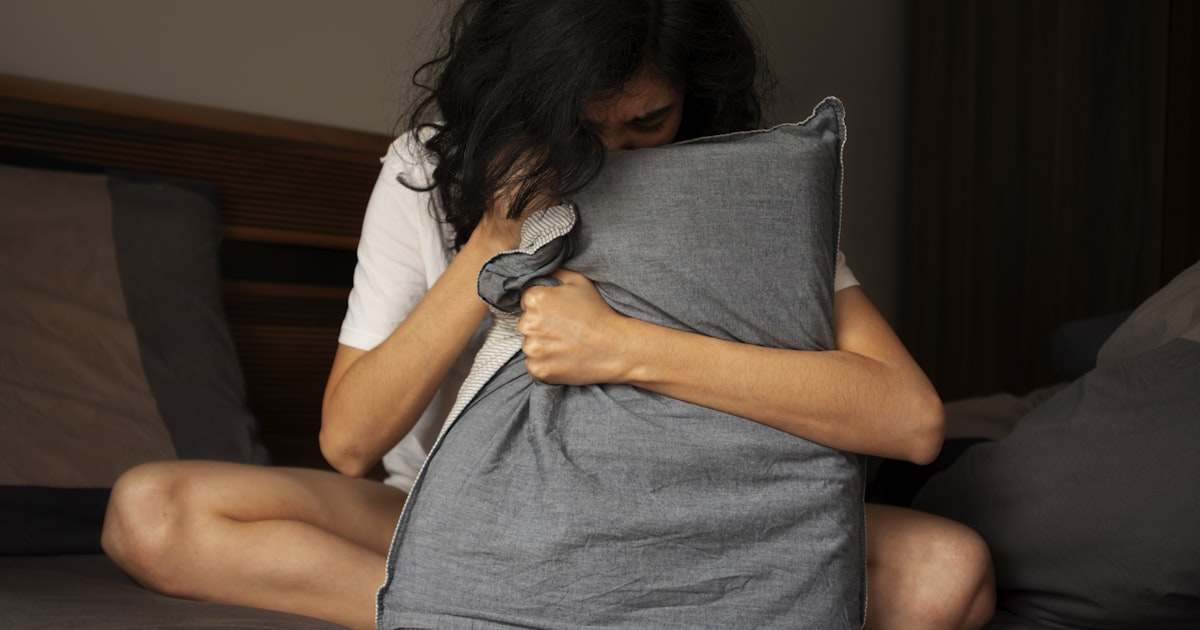
You bought a sleep tracker to sleep better. Three months in, you're checking your score before you've had coffee, lying awake calculating whether you'll hit 8 hours, and feeling tired on the days the app says you slept poorly even when you felt fine.
That's not a bug in your willpower. It's a documented condition with a name, and the name is orthosomnia.
Key facts
- Orthosomnia was coined in 2017 by Baron and colleagues at Rush University to describe people whose preoccupation with perfecting tracker data was making their sleep worse.
- A 2024 cross-sectional study in Brain Sciences estimated orthosomnia prevalence at 3% to 14% of adults, depending on cutoff.
- Chinoy et al. (2021) in SLEEP found consumer trackers had high sensitivity for sleep but specificity for wake as low as 0.18 to 0.54, meaning they routinely score wakefulness as sleep.
- The AASM clinical practice guideline (Edinger et al., 2021) gives a STRONG recommendation for CBT-I as first-line treatment for chronic insomnia, not for sleep trackers.
- In Trauer et al.'s landmark meta-analysis, CBT-I cut sleep-onset latency by 19 minutes and wake after sleep onset by 26 minutes, with effects sustained over time.
What Orthosomnia Actually Is
The term comes from Kelly Baron, Sabra Abbott, and colleagues at Northwestern and Rush, writing in the Journal of Clinical Sleep Medicine. They described three patients who showed up at a sleep clinic chasing perfect tracker numbers and made themselves sick doing it. One man pressured himself to hit eight tracked hours every night. One woman insisted her Fitbit was right after a full polysomnogram showed her sleep was normal. (Baron et al., 2017)
The authors borrowed the structure from "orthorexia," the unhealthy fixation on eating "correctly." Orthosomnia is the same pattern pointed at sleep. The pursuit of perfect data starts driving the behavior. People extend time in bed to inflate the duration number. They lie awake worrying about the score. They feel exhausted on days the app rated poorly, even when they slept fine.
That last point matters. Studies of sleep feedback (including a recent review) have found that being told "you slept poorly" — even when objectively false — measurably affects mood and cognition the next day versus the same actual sleep with positive feedback. Belief about sleep matters as much as sleep itself, and trackers are very good at injecting belief.
Want a follow-up on this topic? Get a note when Komori launches (2027)
One email when the contactless monitor ships, plus the occasional short follow-up on this topic. No spam, leave any time.
The Accuracy Gap Nobody Talks About
Here's the thing about that score you're chasing: the device probably doesn't know what it's talking about.
Consumer trackers measure movement and heart rate. They infer sleep stages. They don't measure brain waves, which is what defines sleep stages in any clinically meaningful sense. The Baron paper put it plainly: trackers track movement, not EEG, and they can't reliably separate light from deep sleep. (Baron et al., 2017)
The benchmarks back that up. Chinoy and colleagues put seven popular consumer trackers head-to-head with polysomnography on 34 healthy adults across three nights. Sensitivity for detecting sleep was high (0.93+ across the board). Specificity for detecting wake was low to medium (0.18 to 0.54). Translation: if you were awake in bed, the device often called it sleep. Two Garmin devices underestimated wake-after-sleep-onset by roughly 48 minutes per night.
de Zambotti's validation of the Oura ring against PSG in adolescents and young adults found Oura underestimated N3 (deep) sleep by about 20 minutes and overestimated REM by about 17 minutes. That's a respected device under controlled conditions. The error is real and structural, not random.
Here's a cleaner view of what consumer trackers actually do well versus what they fake:
| Metric | Consumer tracker accuracy vs PSG | Notes |
|---|---|---|
| Total sleep time | Usually within 10-30 min | Decent on average, worse on bad nights |
| Sleep onset latency | Within ~5 min for most devices | Reasonable |
| Wake after sleep onset | Frequently underestimated by 30-50 min | Devices call wake "sleep" |
| Light sleep duration | Significantly different from PSG | Most devices overestimate |
| Deep / REM stages | Inconsistent, device-dependent | Often off by 15-20 min |
| Sleep score | Proprietary, unvalidated | Different formula on every brand |
Source: Chinoy et al., 2021; de Zambotti et al., 2019.
The score is the most marketed metric and the least defensible one. It's a number a product team picked because users want a number.
How a Tracker Can Manufacture Insomnia
Sleep is involuntary. You can't force it. The harder you try, the worse it gets. This is so well established that sleep researchers have a name for the mechanism: the attention-intention-effort pathway, described by Espie and colleagues. Selective attention to "threatening" sleep cues triggers a conscious intention to sleep, which triggers effort, which triggers arousal, which blocks sleep. (Espie et al., 2006)
Every step of that pathway is something a sleep tracker can crank up.
- Attention. You wear a device that constantly invites you to inspect your sleep. Now sleep is a thing you're watching.
- Intention. The score gives you a target. Hit 85. Get into deep sleep. Don't waste REM.
- Effort. You go to bed earlier. You lie still on purpose. You avoid getting up at 3am because that wrecks the score (more on why you wake up at 3am anyway).
This is also why "lying in bed longer to inflate sleep duration" is so harmful. Sleep restriction (spending less time in bed, not more) is one of the most effective components of CBT-I. Doing the opposite, which is exactly what a duration-obsessed user does, deepens the insomnia.
So the tracker doesn't just observe a problem. It can create the conditions for one.
Who Gets Caught in the Trap
Orthosomnia isn't rare. A 2024 prevalence study in Brain Sciences surveyed 523 adults and found 3% met a conservative cutoff for orthosomnia, 8.6% met a moderate cutoff, and 14% a lenient one. About 36% of the sample owned and used a sleep tracker. The orthosomnia signature correlated with anxiety and insomnia symptoms.
A 2025 paper in Frontiers in Sleep developed and validated the Bergen Orthosomnia Scale, which loads on two factors: interference (the tracker disrupts daily life) and rigidity (rigid rules about how sleep "should" look). Both correlated with sleep effort, dysfunctional sleep beliefs, perfectionism, OCD symptoms, and health anxiety.
Translation: the people most likely to get hurt by a sleep tracker are the ones most likely to buy one. Type-A. Health conscious. Already a little anxious. Already monitoring something else.
If you've ever felt a small drop in your stomach checking your score in the morning, you know the type personally.
What Actually Works for Insomnia
Cognitive Behavioral Therapy for Insomnia (CBT-I). That's the answer. It's been the answer for two decades and the evidence keeps getting stronger.
The 2021 AASM clinical practice guideline gave multicomponent CBT-I a STRONG recommendation as first-line treatment for chronic insomnia in adults. The Trauer et al. meta-analysis of 20 randomized controlled trials, published in Annals of Internal Medicine, found CBT-I produced clinically meaningful reductions in sleep-onset latency (about 19 minutes) and wake after sleep onset (about 26 minutes), and the gains lasted.
CBT-I has five rough components:
- Stimulus control. Bed is for sleep and sex. Get out of bed if you can't sleep.
- Sleep restriction. Compress time in bed to match actual sleep, then expand gradually.
- Cognitive therapy. Challenge the catastrophic thoughts ("if I don't sleep tonight, tomorrow is ruined").
- Sleep hygiene. Caffeine, light, room temperature, screens. The well-known basics.
- Relaxation. Breathing, progressive muscle relaxation, sometimes mindfulness.
Note what's not on that list. A sleep score. A wearable. An app that wakes you in the right "phase." The intervention with the best evidence base for insomnia uses none of those things.
If your sleep is actually bad, your move isn't a better tracker. It's a referral. Ask your primary care doctor or a sleep specialist about CBT-I, in person or via a validated digital program. That's the actual treatment.
How to Use a Tracker Without Hurting Yourself
You probably aren't going to throw your tracker away. Fine. Here's the framing that keeps it useful instead of corrosive.
- Stop checking the score in the morning. Especially before you've decided how you feel. The Baron paper specifically describes patients overriding their actual experience with what the device said.
- Trust your felt experience first. If you feel rested, you slept enough. If you don't, the score doesn't change that.
- Ignore stage data. Light, deep, and REM percentages are the least accurate numbers your tracker produces. Treat them as roughly directional, never as a target.
- Stop spending more time in bed to chase duration. This is the single most insomnia-feeding behavior trackers create.
- Watch trends over weeks, not nights. A single bad night is noise. A six-week pattern is signal.
- If checking the data makes you anxious, stop checking it. The data isn't worth the cost.
If you want a deeper look at why we think movement and behavior are far more honest signals than a score, see what movement actually tells you about sleep and why we don't show a sleep score.
Where Komori Stands
We're building a contactless sleep position monitor. 60GHz radar. No camera, no wearable. On-device microphones classify sound events locally — only audio features are recorded, and raw audio is not kept unless the user explicitly asks for it. Position, movement, and bed-exit events. (Respiratory metrics are a Pro-sensor-suite capability, not a Lite feature.)
We made a deliberate decision early: Komori does not show a sleep score. Not because we couldn't compute one. The data's there. We don't show one because the orthosomnia literature is clear about what scores do to anxious users, and we'd rather build a product that helps you than one that hooks you.
What you get instead is the thing that's actually well-measured: how you moved, when you moved, what positions you spent time in. Data to discuss with your doctor or sleep specialist, not a verdict to feel bad about. If you're working through CBT-I, position and movement trends can give your clinician something honest to look at. They aren't a substitute for clinical care.
If you're tired of waking up to a number that decides how your day starts, the Insider Pass is $49 and fully credited toward your purchase. Talk to your doctor about CBT-I either way. That's the part that actually moves the needle.
If your tracker is making you feel worse, the right move isn't a better tracker. It's less tracker, more sleep, and a real intervention that's been proven to work.
Want a follow-up on this topic? Get a note when Komori launches (2027)
One email when the contactless monitor ships, plus the occasional short follow-up on this topic. No spam, leave any time.
Keep reading
Want to see your sleep position data?
Join the free waitlist for launch updates. Or lock in founder pricing with the Insider Pass ($49, credited toward your purchase).