Is It Bad to Work Out Before Bed? What 23 Studies Found
Dovy Paukstys
Founder, Komori Care
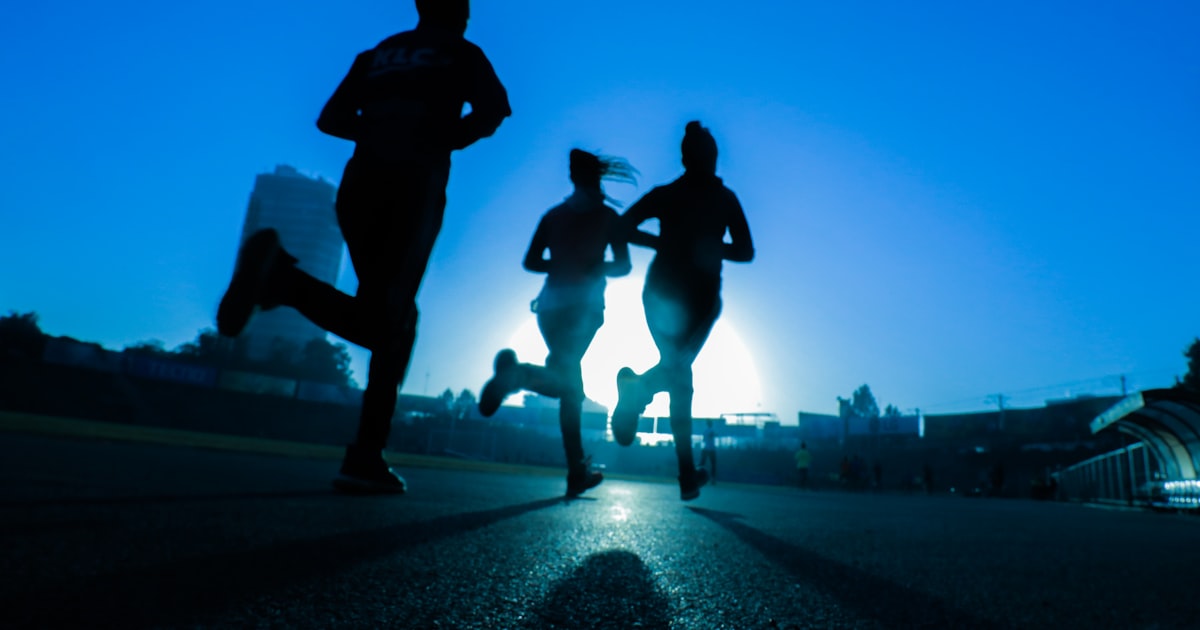
You've Been Told Not to Do This
Every sleep hygiene handout says some version of the same line: don't exercise within three hours of bedtime. It's in doctor's office pamphlets. It's in every app. It has the confident, tidy sound of a rule somebody checked.
Mostly, nobody checked. For the average person doing an average workout, the research does not support it. Controlled trials find that evening exercise generally leaves sleep alone, and sometimes improves it.
But there's a real exception buried in there, and the newest and largest data makes it sharper than the older meta-analyses did. So this isn't a "the rule is a myth, do whatever" post. It's a "the rule is aimed at the wrong thing" post.
Let's go through what was actually measured.
Key Facts
- Across 23 controlled studies, evening exercise increased deep sleep by 1.3 percentage points and cut lightest-stage sleep (Stutz et al., 2019)
- The exception: sleep may be impaired after vigorous exercise ending 1 hour or less before bedtime (Stutz et al., 2019)
- Hard evening exercise finishing 2 to 4 hours before bed did not disrupt sleep in healthy adults (Frimpong et al., 2021)
- Across 153,154 real-world nights, evening activity was not linked to worse sleep efficiency and preceded earlier sleep onset by about 14 minutes (Kahn et al., 2021)
- In over 4 million nights, harder and later exercise tracked with later sleep onset and shorter sleep; sessions ending 4+ hours before sleep showed no association (Leota et al., 2025)
- Across 66 studies, regular exercise had moderate benefits for sleep quality and small-to-medium benefits for falling asleep faster (Kredlow et al., 2015)
Want a follow-up on this topic? Get a note when Komori launches (2027)
One email when the contactless monitor ships, plus the occasional short follow-up on this topic. No spam, leave any time.
What the Controlled Trials Found
Start with the cleanest evidence: lab studies where researchers put people through an evening workout, then measured their sleep with electrodes.
Stutz and colleagues pooled 23 such studies in a 2019 meta-analysis. Compared with no exercise, evening exercise:
- Increased slow-wave sleep by 1.3 percentage points (that's deep sleep, the restorative kind)
- Decreased stage 1 sleep by 0.9 percentage points (that's the lightest, least useful stage)
- Pushed REM latency 7.7 minutes later (REM latency is how long after falling asleep you reach your first dream sleep) 1
Read the direction of those numbers. More deep sleep, less light sleep. That's the profile of a slightly better night, not a worse one. The authors' overall conclusion was that evening exercise does not negatively affect sleep in healthy people.
A second meta-analysis looked specifically at the scary case: high-intensity exercise in the evening. Frimpong and colleagues found that hard sessions ending anywhere from half an hour to four hours before bed produced a small drop in REM sleep, about 2.34 percentage points. But their conclusion was direct: hard evening exercise performed 2 to 4 hours before bedtime does not disrupt nighttime sleep, and regular evening high-intensity training didn't either 2.
So the three-hour rule, as a blanket statement, is not supported by the trial evidence.
Then the Big Datasets Showed Up
Lab studies have a weakness: small groups, one night, unusual conditions. Two enormous wearable-based studies filled that gap, and they don't say quite the same thing as each other.
The first tracked 12,638 people across 153,154 nights. Sleep efficiency showed no association with evening physical activity. Nights following at least 30 minutes of moderate-to-hard activity had 3.4 minutes more sleep on average, and evening activity preceded sleep onset about 13.7 minutes earlier. The authors titled the paper "Is It Time We Stop Discouraging Evening Physical Activity?" which tells you where they landed 3.
The second is much larger and more nuanced. A 2025 study in Nature Communications followed 14,689 physically active people across more than 4 million nights. It found a genuine dose-response pattern: the later the session and the harder the strain, the later sleep started, the shorter it ran, the worse it scored, and the higher overnight resting heart rate stayed. And the clean line in the data: sessions ending 4 or more hours before sleep onset showed no association with changes in sleep 4.
That's an observational study in people who wear fitness trackers, so it shows association, not proof of cause. But four million nights is a lot of nights, and it points at something the small lab studies were underpowered to see.
Put both together and the honest answer is: it's not the clock, it's the combination of how hard and how close.
Where the Rule Came From
The rule isn't invented out of nothing. There's a real mechanism underneath it, and it's about temperature.
Your core body temperature normally falls in the hours around sleep onset, and that fall is part of what triggers sleep. It starts dropping roughly two hours before you fall asleep, and how much your hands and feet warm up — which is how your body dumps heat — is one of the better predictors of how fast you'll fall asleep 5.
Exercise runs that process backwards. It raises core temperature and keeps it up for a while afterward. If you finish a hard session and get straight into bed, your body is still trying to shed heat at the exact moment it needs to be cooling toward sleep.
This isn't hand-waving. The Stutz meta-analysis tested it directly and found that higher body temperature at bedtime was associated with reduced sleep efficiency and more time awake after falling asleep 1. So the mechanism is real. The mistake was turning a mechanism into a three-hour ban for everyone.
If you want the full temperature picture, we went deep on how temperature affects sleep separately.
The Actual Exception
Here's the exception, stated as narrowly as the evidence allows.
Stutz and colleagues found that time to fall asleep, total sleep time, and sleep efficiency might be impaired after vigorous exercise ending 1 hour or less before bedtime 1. The 2025 wearable study extends the caution outward for harder sessions, showing the effect fading as you get further from bedtime and disappearing by about four hours 4.
Notice what is not in that exception:
- A brisk walk after dinner
- Yoga, stretching, mobility work
- An easy bike ride
- Moderate lifting at 7 PM
- Basically any workout that ends more than a couple of hours before you get in bed
The exception is for hard efforts finishing close to lights out. If your session leaves you red-faced and still breathing heavily twenty minutes later, and you're getting into bed in forty, that's the case the research is warning about.
| Workout and timing | What to expect | Based on |
|---|---|---|
| Walk after dinner, 2+ hr before bed | Neutral to slightly helpful | 1 3 |
| Moderate lifting or cycling, 2–4 hr before bed | No meaningful disruption | 2 3 |
| Hard intervals, 2–4 hr before bed | Small REM dip, sleep otherwise fine | 2 |
| Hard intervals, under 1 hr before bed | Slower to fall asleep, less total sleep | 1 |
| Any hard session, 4+ hr before sleep | No association with sleep changes | 4 |
| Regular exercise, any reasonable time | Moderate improvement in sleep quality | 6 |
| Skipping the workout entirely | Loses those benefits | 6 |
The Comparison Nobody Makes
Every discussion of this treats the choice as "evening workout versus morning workout." For most working adults, that is not the choice.
The real choice is evening workout versus no workout. Kids, commutes, jobs, and the fact that 6 AM is a difficult time to be a person mean that the gym at 8 PM is often the only version available.
So compare against the right alternative. A meta-analysis of 66 studies found that regular exercise produced moderate improvements in sleep quality, small-to-medium improvements in how fast people fell asleep, and small improvements in total sleep time and sleep efficiency. Single sessions helped too, including a moderate reduction in time spent awake after falling asleep 6.
Meanwhile the real-world data suggests the evening penalty for ordinary exercise rounds to nothing, and one study measured it as a small benefit 3.
Trading a real, repeatable improvement in sleep quality for the avoidance of a hypothetical few minutes of delay is a bad trade. Do the workout.
Worth adding: only 12.4% of evenings in that 153,000-night dataset included even 30 minutes of moderate-to-hard activity in the three hours before bed 3. Most people are not overtraining at night. Most people are on the couch.
What I'd Actually Do
Keep the evening workout. If it's the only slot you'll reliably use, it's the right slot.
Give yourself a buffer after hard sessions. Aim to finish intense work two or more hours before bed if you can, and four if it's a truly brutal one. Not because of a rule, because of your body temperature curve.
Cool down deliberately. A shower, cooler room, lighter bedding. You're trying to help heat leave, which is the same reason it takes some people forever to fall asleep in a warm bedroom.
Watch your own data, not the average. Meta-analyses describe groups. If Tuesday night intervals reliably wreck you, that's real for you even if the average says otherwise. Restlessness through the night is one of the more honest signals here, and we wrote about what movement says about sleep.
Consider other timing factors too. Evening exercise is one variable, but caffeine timing (when to stop caffeine) and light exposure (how light affects your body clock) also shape your sleep — the research shows each has different cutoff rules.
Where Komori Fits
Komori is a wellness device, not a medical one. It isn't designed to detect, diagnose, or monitor any condition, and it doesn't track workouts.
What it's being built to record, contactlessly and with no camera or wearable, is what the night itself looked like: sleep position, movement and restlessness, bed-exit events, and room conditions like temperature, humidity, light, and sound.
Why that's relevant to this particular question: "did the late workout hurt my sleep?" is a personal question that a meta-analysis cannot answer. It needs your nights, plenty of them, with and without. Once it ships, someone might line up their restless nights against their training schedule and find that late hard sessions cost them nothing — or that they clearly do. Either answer is useful. Neither is a diagnosis, and it isn't meant to be one.
The Bottom Line
The three-hour rule is aimed at the wrong variable. Timing alone isn't the problem. Hard plus close is the problem, and even that fades within a few hours.
Exercise is one of the few things with solid evidence behind it for sleeping better. Don't skip it to obey a pamphlet. Just don't sprint into bed.
And if your sleep is bad on the nights you train and the nights you don't, exercise timing isn't the issue — that's worth raising with your doctor.
Footnotes
-
Stutz J, Eiholzer R, Spengler CM. "Effects of Evening Exercise on Sleep in Healthy Participants: A Systematic Review and Meta-Analysis." Sports Medicine, 2019. ↩ ↩2 ↩3 ↩4 ↩5
-
Frimpong E, Mograss M, Zvionow T, Dang-Vu TT. "The effects of evening high-intensity exercise on sleep in healthy adults: A systematic review and meta-analysis." Sleep Medicine Reviews, 2021. ↩ ↩2 ↩3
-
Kahn M, Korhonen T, Leinonen L, et al. "Is It Time We Stop Discouraging Evening Physical Activity? New Real-World Evidence From 150,000 Nights." Frontiers in Public Health, 2021. ↩ ↩2 ↩3 ↩4 ↩5
-
Leota J, Presby DM, Le F, et al. "Dose-response relationship between evening exercise and sleep." Nature Communications, 2025. ↩ ↩2 ↩3
-
Harding EC, Franks NP, Wisden W. "The Temperature Dependence of Sleep." Frontiers in Neuroscience, 2019. ↩
-
Kredlow MA, Capozzoli MC, Hearon BA, Calkins AW, Otto MW. "The effects of physical activity on sleep: a meta-analytic review." Journal of Behavioral Medicine, 2015. ↩ ↩2 ↩3
Want a follow-up on this topic? Get a note when Komori launches (2027)
One email when the contactless monitor ships, plus the occasional short follow-up on this topic. No spam, leave any time.
Keep reading
Want to see your sleep position data?
Join the free waitlist for launch updates. Or lock in founder pricing with the Insider Pass ($49, credited toward your purchase).