What Wearable Data Shows About Student Sleep
Dovy Paukstys
Founder, Komori Care
It Isn't Laziness
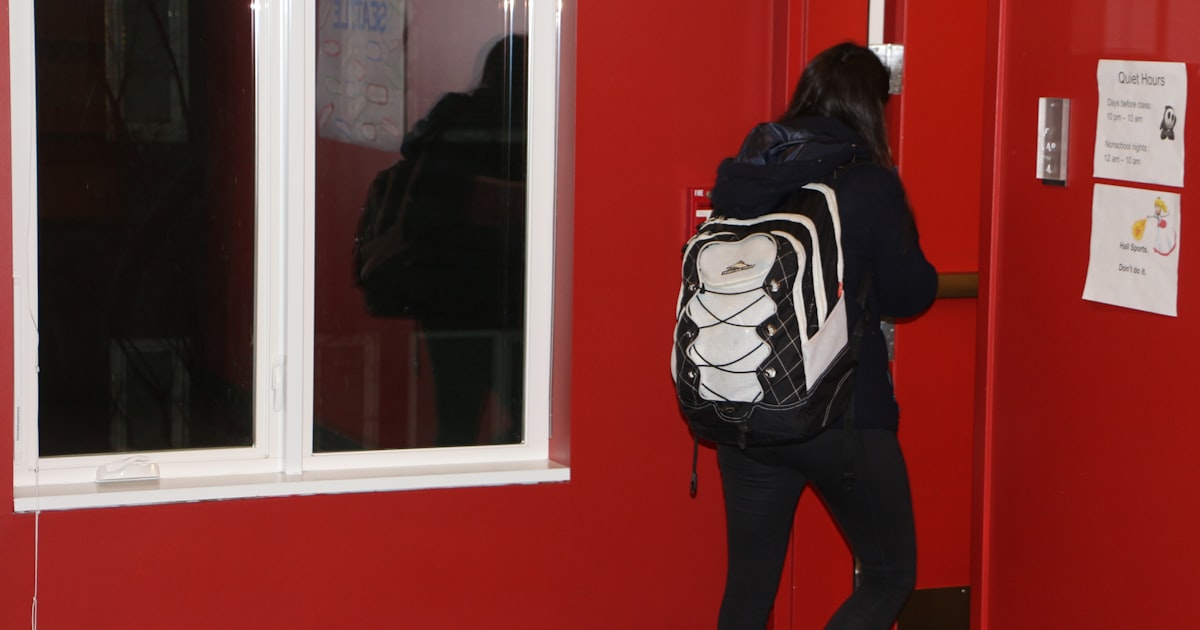
School is back in session, which means a familiar argument is back too. A teenager who won't go to bed and can't get up. A parent who's tried everything. The word "lazy" hovering over the whole thing.
Here's the part that argument usually misses: the biology of teenage and young-adult sleep timing really does run late. Not as an excuse. As a measurable, repeatedly documented shift in when the body wants to sleep.
Wearable devices have made this easier to see than it used to be, because researchers can now watch hundreds of students sleep for months at a stretch instead of asking them to fill out a survey.
This post is educational, not medical advice. If a student in your life is exhausted every day no matter what, that's worth a doctor's attention, not another lecture.
Key Facts
- In 582 first-semester college students wearing rings, the median midpoint of sleep was 5 AM — the middle of the night, not the start of it (2024 arXiv preprint)
- Sleep pressure builds more slowly in older, post-pubertal teens, which lets them stay up later before feeling tired (Journal of Adolescence, 2018)
- Younger teens fell asleep about 1 hour into their biological night; older teens fell asleep about 2 hours in (Journal of Adolescence, 2018)
- The average US public school started at 8:03 AM, and only 17.7% started at 8:30 AM or later (CDC MMWR, 2015)
- 57.8% of middle schoolers and 72.7% of high schoolers got less sleep than recommended (CDC MMWR, 2018)
- The AASM recommends middle and high schools start at 8:30 AM or later, and 8 to 10 hours of sleep for teens aged 13 to 18 (AASM, 2017)
What The Biology Actually Does
Two separate things change during adolescence, and they push in the same direction.
The clock moves later
Everyone has an internal body clock that decides when your biological night starts. During adolescence, that clock shifts later. The technical name for the pattern is delayed sleep phase, and it's common enough in this age group that a reference text on circadian physiology notes delayed sleep phase disorder is "more common in adolescents" [^1].
So the teenager who isn't sleepy at 10 PM often isn't being difficult. Their biological night hasn't started yet.
Sleep pressure builds slower
The second change is subtler and more interesting. Your drive to sleep builds the longer you've been awake — that's the pressure that makes you nod off on the couch.
In adolescents, that pressure builds more slowly as they mature. A 2018 review of adolescent sleep states it directly: "sleep pressure builds more slowly in more mature adolescents (i.e., post pubertal) as compared to younger (pre-/early pubertal) adolescents," which allows "older teens to better withstand increased sleep pressure and thus delay bedtimes" [^2].
Put both together and you get what researchers call the perfect storm: a clock that says "not yet" and a pressure system that lets them stay up long enough to obey it.
The same review quantifies how far this goes. Young adolescents aged 9 to 13 fell asleep about 1 hour after their biological night began. Older adolescents aged 15 to 18 fell asleep about 2 hours into it [^2]. The gap between when their body starts its night and when they actually sleep roughly doubles.
What Wearables See In Real Students
Now the data.
A 2024 preprint — not yet peer reviewed — followed 582 college students through their first semester using Oura Gen3 rings. This is the kind of study that used to be impossible: continuous, months-long, hundreds of people, in their actual dorm rooms rather than a lab.
The headline finding is stark. Most students had a late-night chronotype with a median midpoint of sleep at 5 AM [^3]. Midpoint of sleep is exactly what it sounds like — the halfway mark between falling asleep and waking. A 5 AM midpoint means the typical student's sleep was centered on the hour most people think of as almost-morning.
The study also found that males and students with mental health impairment had even more delayed sleep periods, and that "social jetlag... is prevalent in our sample" [^3].
And the duration finding, which is the one worth sitting with: sleep periods shifted earlier on weekdays and later on weekends, but sleep duration on both weekdays and weekends was shorter than during prolonged school breaks — which the authors read as "chronic sleep debt when school is in session" [^3].
Read that again. Even on weekends, during the semester, students slept less than they did on break. The catch-up isn't catching up.
Social Jetlag: The Weekday-Weekend Swing
That weekend shift has a name. Social jetlag is the gap between when you sleep on free days and when you sleep on obligated days. It's calculated as the difference between your sleep midpoint on free days and your sleep midpoint on work or school days [^4].
It is not a fringe phenomenon. A 2021 review reports that in industrialized countries, roughly two-thirds of the studying and working population experiences social jetlag, and that "70% of students and workers experience at least one hour," with almost half experiencing two hours or more [^4].
The review links social jetlag to worse sleep quality, metabolic changes, and mood symptoms. Those are associations in observational data, not demonstrated causes. Real, worth knowing, and not proof that the swing itself is doing the damage.
Practically, though, the mechanism is easy to picture. A student whose body wants a 5 AM sleep midpoint, forced to a 6:30 AM alarm five days a week, is waking in their biological night five times a week. Then on Saturday they sleep to their body's schedule, and Monday resets the whole thing. It's the flight-crew life without the flight. We covered the catch-up question in weekend sleep debt.
The School Start Time Evidence
This is where the biology collides with the calendar.
| The recommendation | The reality |
|---|---|
| Schools should start at 8:30 AM or later (AASM, 2017) | Average US public school start time: 8:03 AM 1 |
| Teens 13–18 should get 8 to 10 hours (AASM, 2017) | 72.7% of high schoolers got less 2 |
| Children aged 6–12 need 9 to 12 hours 2 | 57.8% of middle schoolers got less than recommended 2 |
| Later starts should be the norm | Only 17.7% of schools started at 8:30 AM or later 1 |
The CDC surveyed roughly 39,700 US public middle, high, and combined schools for the 2011–12 year. Average start: 8:03 AM. Share starting at 8:30 AM or later: 17.7% 1.
The American Academy of Sleep Medicine's 2017 position statement asks schools to start at 8:30 AM or later, and lists what the evidence associates with later starts: longer total sleep, less daytime sleepiness, better classroom engagement, fewer tardies and absences, fewer depressive symptoms, better reaction time, and improved driving safety 3.
The 2018 adolescent sleep review agrees on the diagnosis, calling school start times "the major societal constraint on adolescents' sleep," and notes that delaying them "increased attendance, improved high school enrollment, and showed some improvement in grades" 4.
A student with a biologically late clock, given a 7:30 AM first bell, cannot get 8 to 10 hours without going to bed before their body will let them. The arithmetic doesn't work. That's not a motivation problem. That's a scheduling problem wearing a motivation costume.
Why "Just Go To Bed Earlier" Fails
Because bedtime is not the lever people think it is.
You can send someone to bed at 9:30 PM. You cannot make their body start its night at 9:30 PM. If their internal night begins at midnight, the extra two and a half hours get spent lying awake — which is miserable, teaches the brain that bed is a place for frustration, and doesn't add sleep.
The clock does move. It just responds to light, not to instructions. We laid out the practical side in light exposure and your body clock.
What Actually Helps
Short list, strongest first:
- Morning light, early and real. Getting outside soon after waking is the strongest everyday tool for pulling a late clock earlier.
- Dim the last hour. Bright light late pushes the clock later — the opposite of the goal.
- Shrink the weekend swing. You don't have to wake at 6:30 on Saturday. But an extra four hours reopens the gap every week. Keeping the difference to about an hour is a reasonable target.
- Move in small steps. Fifteen to twenty minutes at a time, held for several days. See body clock habits, not heroics.
- Advocate on start times. This one isn't individual. The CDC and AASM numbers above are the argument, and school boards do respond to them.
And stop calling it laziness. The data doesn't support it, and the word does damage.
Where Komori Fits
Komori is being built as a contactless system: a sensor that mounts above the bed, where the sensing happens, plus a base unit on the nightstand for power, Wi-Fi, and local processing. No camera. Nothing worn — which matters for a demographic that regularly forgets to charge things.
When it ships, it's designed to log sleep position, movement and restlessness, bed-exit events, and room conditions like temperature, humidity, CO2, light and noise. It's a general wellness device. It doesn't diagnose anything and it isn't a sleep study.
For this topic, the useful piece is the timing pattern across a semester: what time sleep actually started, what time it actually ended, and how big the weekday-to-weekend swing really is. Most families are arguing about a schedule nobody has actually measured. A number is a better basis for that conversation than a memory.
The Bottom Line
Students sleep late because their clocks run late, and sleep short because school starts early. Both halves are documented. Neither is a character flaw.
Fix what's fixable — light in the morning, dimness at night, a smaller weekend swing — and push on the part that isn't individual, which is the bell schedule.
And if a student is exhausted no matter what the schedule looks like, stop troubleshooting and see a doctor. Persistent daytime sleepiness in a young person has real causes worth ruling out, and none of them get solved by trying harder.
Footnotes
-
Wheaton AG, Ferro GA, Croft JB. "School Start Times for Middle School and High School Students — United States, 2011–12 School Year." MMWR Morbidity and Mortality Weekly Report, 2015. ↩ ↩2 ↩3
-
Wheaton AG, Jones SE, Cooper AC, Croft JB. "Short Sleep Duration Among Middle School and High School Students — United States, 2015." MMWR Morbidity and Mortality Weekly Report, 2018;67(3):85-90. ↩ ↩2 ↩3
-
American Academy of Sleep Medicine. "AASM position: Delaying middle school, high school start times is beneficial to students." 2017, announcing Watson NF, et al., Journal of Clinical Sleep Medicine, 2017. ↩
-
Crowley SJ, Wolfson AR, Tarokh L, Carskadon MA. "An Update on Adolescent Sleep: New Evidence Informing the Perfect Storm Model." Journal of Adolescence, 2018;67:55-65. ↩
You can choose a position at lights-out. Knowing what you held until morning is the hard part.
Komori is a contactless monitor that logs which position you slept in, through blankets, with no camera and nothing to wear. Pre-launch — join the list and we'll tell you when it ships.
Keep reading
Want to see your sleep position data?
Join the free waitlist for launch updates. Or lock in founder pricing with the Insider Pass ($49, credited toward your purchase).