Why Your Phone Can Tell You Slept Badly
Dovy Paukstys
Founder, Komori Care
Your Phone Already Knows What Time You Gave Up
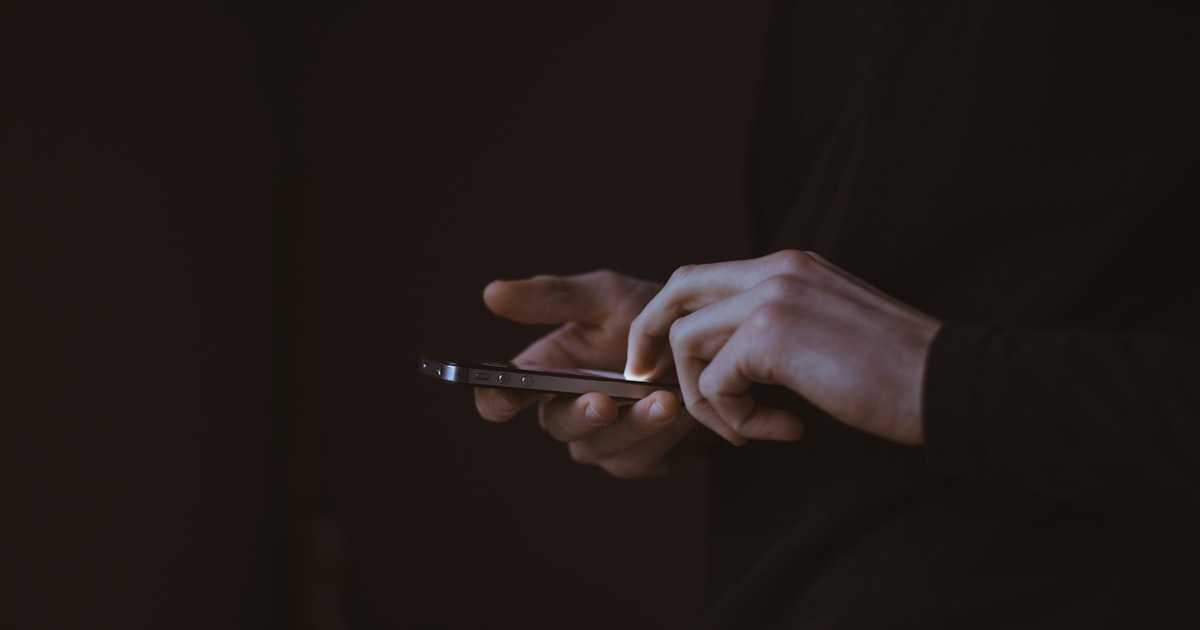
Last night your phone recorded the exact minute you stopped scrolling. It recorded the minute you picked it up again. It knows how many times you tapped, how fast you typed, how long each app stayed open, and how much you moved.
Nobody had to ask you anything. You just used your phone like a person.
Researchers figured out a while ago that this stream of ordinary behavior is a usable proxy for sleep. Not a measurement of sleep — a proxy, which is a different and weaker thing. The field calls it digital phenotyping: inferring something about your health from how you interact with a device.
It works better than you'd expect. It also fails in ways that matter, and it raises a privacy question most people have never thought about, because thinking about it requires knowing it's happening.
Key Facts
- Smartphone touchscreen timing tracked sleep-onset and wake times against wrist actigraphy with R² of 0.84 and 0.90 across ~1,400 nights (npj Digital Medicine, 2019)
- In that study, about 80% of participants regularly used their phones during periods actigraphy had scored as sleep (npj Digital Medicine, 2019)
- A 2024 validation found app-derived and actigraphy sleep onset and wake times didn't differ significantly, but total sleep time differed by about 20 minutes (JMIR, 2024)
- A 2026 preprint (not yet peer reviewed) linked screen-time and app-usage features to fatigue and sleep scores in 137 people across six disease groups (arXiv)
- Four location-time points identified 95% of individuals in a 1.5-million-person mobility dataset (Scientific Reports, 2013)
- 92% of studied mental-health apps transmitted data to third parties; most never disclosed it (JAMA Network Open, 2019)
The Signal Is Absence, Not Presence
Here's the clever bit, and it's simpler than you'd guess.
To infer sleep from a phone, you don't look for a sleep signal. You look for a hole — the longest stretch in each 24 hours where nothing happened. No unlocks, no taps, no app switches. Then you call the start of the hole "sleep onset" and the end "wake time."
Researchers sometimes call this tappigraphy, because the raw material is touchscreen taps and their timestamps. It's the opposite of a sensor. A sensor detects something. This detects the absence of you.
The appeal is obvious. No wearable to charge, no strap, no compliance problem. Everybody already carries the sensor.
How Well Does It Actually Work?
Better than it has any right to.
A 2019 study logged touchscreen events from 79 people over roughly 1,400 nights and compared the results against wrist actigraphy — a motion-based estimate of sleep that's the standard research fallback when a full sleep lab isn't practical. Sleep-onset times matched with an R² of 0.84, and wake-up times with an R² of 0.90 [^1]. In plain terms: knowing the phone data lets you predict the actigraphy answer most of the time.
A 2024 study went further and used smartphone interaction to estimate circadian rhythm measures, comparing an app against actigraphy in 78 participants across 2,182 person-days. Sleep onset and wake times showed no significant difference between methods. But the app logged more wakefulness during the night, and actigraphy ended up with a total sleep time about 20.2 minutes longer. Measures of day-to-day rhythm stability came out significantly lower from the app [^2].
That last finding is the honest one. The endpoints agree. What happens between them does not.
And notice which direction the disagreement runs. In the 2019 study, roughly 80% of participants regularly used their phones during periods that actigraphy had already scored as sleep [^1]. The authors' read is that actigraphy overestimates real sleep — lying still with a phone in your hand looks identical to sleeping if all you measure is wrist motion.
So which one is wrong? Both, a bit, in opposite directions. Neither is a sleep study. This is the same problem we walked through in how wearables handle sleep staging: the reference standard matters enormously, and consumer comparisons rarely use the best one.
It's Not Just Bedtimes Anymore
Timing is the easy part. The more interesting work looks at how you use the phone, not just when.
A 2026 preprint — not yet peer reviewed — from a European research consortium tested this in 137 participants across six disease groups plus healthy controls, all living with neurodegenerative or chronic inflammatory conditions. The team pulled screen-time and app-usage features from participants' phones and correlated them against standardized questionnaire scores for fatigue, sleep, and activity [^3].
Their framing of the problem is fair. Questionnaires have a "propensity to exhibit biases derived from its subjective nature, or the low sensibility to changes." Ask someone how tired they were last Tuesday and you get a story, not a measurement. The paper's conclusion is that phone interaction data can serve as "an effective, reliable, and objective assessment" of fatigue, sleep disturbance, and activity change in those groups [^3].
Take that as a promising direction, not a settled result. It's a preprint, the correlations are group-level, and "correlates with a questionnaire score" is a long way from "knows how you slept."
But the direction is clear enough. Speed, error rate, session length, and time-of-day patterns are all downstream of how sharp your brain is. Tired brains type differently.
Where It Falls Apart
Every one of these methods rests on one assumption: your phone use faithfully mirrors your consciousness. Break that assumption and the whole thing collapses quietly, without an error message.
| Situation | What the phone concludes | What actually happened |
|---|---|---|
| Phone charges in the kitchen | Sleep started at 10:00 p.m. | You read a paperback until 12:30 |
| Shared tablet or family device | One person's chaotic sleep | Three people's normal sleep |
| Night-shift worker | No coherent sleep period | Sleep from 9 a.m. to 4 p.m. |
| You lie awake without touching the phone | Solid uninterrupted sleep | Three hours staring at the ceiling |
| You watch a long video in bed | Awake and active | Asleep 20 minutes in 1 |
| Daytime nap | Nothing | An hour of sleep 1 |
The 2019 researchers name several of these themselves: the method can't detect daytime naps, can't be trusted for people who don't follow a 24-hour cycle, and misses "wakeful periods where the person is engaged in activities like watching long videos on the phone." Their sample was also almost entirely young adults, and they're explicit that the approach "must be tested against polysomnography" before it substitutes for anything 1. The 2024 team was equally direct that their methods "have not been validated against the gold standard measures" 2.
Notice the shape of the failures. They aren't random noise. They're systematic and they cluster in specific people — shift workers, older adults, people who read on paper, households that share devices, anyone with a phone habit that isn't the researcher's habit. A method that quietly works worse for those groups isn't neutral.
Nobody Signed Up For This
Now the part that deserves more attention than it gets.
Phone behavior data is not anonymous in any practical sense. In a landmark analysis of a mobility dataset covering 1.5 million people, researchers found that "four randomly chosen points are enough to uniquely characterize 95% of the users," and that two points still pinned down more than half 3. Behavioral traces are fingerprints. Stripping the name off does very little.
And the apps handling this kind of data have not earned a lot of trust. A 2019 audit of 36 top-ranked depression and smoking-cessation apps found 33 of 36 (92%) transmitted data to third parties, with 29 of 36 (81%) sending data to Google or Facebook for advertising, marketing, or analytics. Of the 28 apps sending data to Google, only 12 disclosed it in a privacy policy. The authors' conclusion: "most apps offer users no way to anticipate that data will be shared in this way" 4.
None of that is about sleep specifically. That's the point. Your sleep inference is a byproduct of a data pipeline built for something else entirely.
Here's what I'd ask people to sit with. When you agree to a wearable or a sleep app, you're making a fairly bounded trade: you know roughly what it watches, and you can take it off. Phone-behavior inference is different in kind. The instrument is the thing you use for everything. It sees your sleep because it sees your entire waking life, and the sleep estimate is just one thing you can compute from that.
A Sensor That Only Watches a Bed
I want to draw a line here, and I'll admit it's a line I have an interest in drawing.
There's a real difference between a system that infers your state from your behavior everywhere, and a system that observes one physical space and nothing else. Both collect data. They are not the same kind of exposure.
A bedroom sensor has a hard boundary: it sees a bed, and only when you're in it. It doesn't follow you to work. It doesn't know what you typed, who you texted, or which apps you opened at 2 a.m. The scope is fixed by physics, not by policy. Policy can change. Physics doesn't.
That's the argument, anyway. You can read our fuller version in how sleep trackers compare on privacy and our privacy-first principles.
Where Komori Fits
Komori is being built on the narrow-scope side of that line, on purpose.
It's a contactless system: a sensor that mounts above the bed and senses from there, plus a base unit on the nightstand that handles power, Wi-Fi, and local processing. No camera. No wearable. No phone-usage tracking, no app-activity logging, no keystroke timing, no location history. When it ships, the design scope is sleep position, movement and restlessness, bed-exit events, sound events, and room conditions — temperature, humidity, CO2, light, and noise.
It's a general wellness device, not a medical one, and it doesn't diagnose anything. The AASM's position on consumer sleep technology is that these tools "cannot be utilized for the diagnosis and/or treatment of sleep disorders," though they "may be utilized to enhance the patient-clinician interaction" when presented alongside a proper evaluation 5. That's the correct frame, and we're not going to pretend otherwise.
What To Do With Any Of This
If you're curious what your phone thinks of your nights, go look. Most phones expose screen-time data, and the last-unlock and first-unlock times are a decent rough sketch of the hole in your day.
Just hold it loosely. It's an estimate built from a proxy, and it will be confidently wrong on the nights that differ most from your normal — which are usually the nights you actually care about.
And if the real question underneath the curiosity is "why do I feel this bad," a chart of unlock times won't answer it. Persistent bad sleep is worth an appointment. Bring the pattern, not the conclusion, and let a clinician tell you what it means.
Footnotes
-
Borger JN, Huber R, Ghosh A. "Capturing sleep-wake cycles by using day-to-day smartphone touchscreen interactions." npj Digital Medicine, 2019. ↩ ↩2 ↩3
-
Chuang HH, et al. "Comparing Human-Smartphone Interactions and Actigraphy Measurements for Circadian Rhythm Stability and Adiposity: Algorithm Development and Validation Study." Journal of Medical Internet Research, 2024. ↩
-
de Montjoye YA, Hidalgo CA, Verleysen M, Blondel VD. "Unique in the Crowd: The privacy bounds of human mobility." Scientific Reports, 2013. ↩
-
Huckvale K, Torous J, Larsen ME. "Assessment of the Data Sharing and Privacy Practices of Smartphone Apps for Depression and Smoking Cessation." JAMA Network Open, 2019;2(4):e192542. ↩
-
Khosla S, et al. "Consumer Sleep Technology: An American Academy of Sleep Medicine Position Statement." Journal of Clinical Sleep Medicine, 2018;14(5):877-880. ↩
You can choose a position at lights-out. Knowing what you held until morning is the hard part.
Komori is a contactless monitor that logs which position you slept in, through blankets, with no camera and nothing to wear. Pre-launch — join the list and we'll tell you when it ships.
Keep reading
Want to see your sleep position data?
Join the free waitlist for launch updates. Or lock in founder pricing with the Insider Pass ($49, credited toward your purchase).