The Clock Change Is Coming. Here's What It Does to You.
Dovy Paukstys
Founder, Komori Care
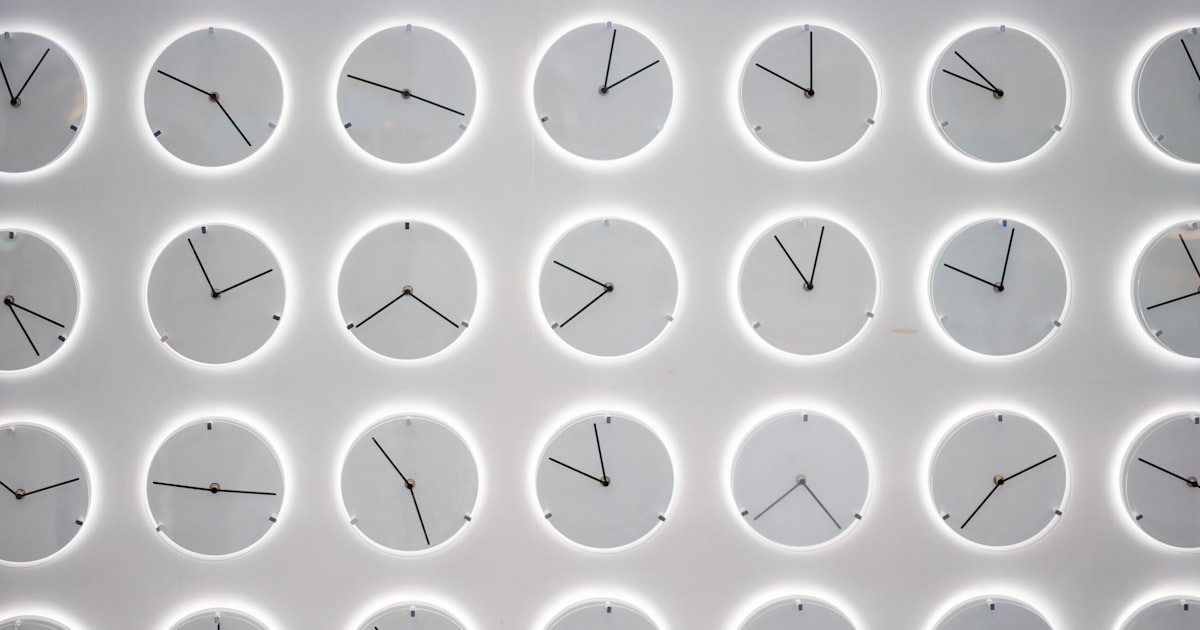
Six Days From Now, Everything Shifts an Hour
On Sunday, November 1, 2026, at 2 a.m., clocks across most of the United States fall back to 1 a.m. Daylight saving time ends. You get an hour.
Most people treat this as the good one. The easy one. The one where you sleep in. That's half right — the fall change is measurably gentler than the spring change. But the "extra hour" framing misses what's actually happening, and it's why some people feel off for a week afterward and can't say why.
The hour isn't the problem. The mismatch is. Your body doesn't run on the clock on the wall. It runs on light. Move the clock and you haven't moved the sun — you've just changed which part of the daylight your schedule lands on, overnight, with no warning.
This post covers what the transition does, why spring is worse than fall, what the evidence really supports (and where it's thin), and what to do this week.
Key Facts
- On the Sunday of the fall change, measured sleep was 33 minutes longer than the Sunday before; in spring it was 65 minutes shorter (de Lange et al., J Sleep Res 2025)
- Fatal traffic crashes rose about 6% in the week after the spring change across 732,835 US crashes, 1996–2017. No effect after the fall change (Fritz et al., Current Biology 2020)
- Heart attack risk rose modestly after spring (OR 1.05), not significantly after autumn across 7 studies and 115,000+ people (Manfredini et al., J Clin Med 2019)
- A 2024 meta-analysis found the same pattern — spring RR 1.04, autumn not significant — but flagged "moderate to marked heterogeneity" between studies (Hurst et al., Dtsch Arztebl Int 2024)
- The AASM's formal position: the US should adopt permanent standard time, which "aligns best with human circadian biology" (AASM position statement, 2024)
- The circadian clock delays when you get evening light or lose morning light — the exact combination daylight saving time creates (AASM, 2024)
Want a follow-up on this topic? Get a note when Komori launches (2027)
One email when the contactless monitor ships, plus the occasional short follow-up on this topic. No spam, leave any time.
It's Not the Hour. It's the Light.
Your internal clock — the circadian system — gets set by light hitting your eyes, especially in the morning. That's not a metaphor. It's a measurable input-output relationship.
The American Academy of Sleep Medicine states the mechanism plainly: "the circadian clock responds to timed light in a predictable fashion: delaying phase when exposed to light in the evening or deprived of light in the morning" 1.
Read that carefully, because daylight saving time does both at once. By shifting clock time forward relative to the sun, DST pushes your morning alarm into darkness and pushes your evening activity into more light. The AASM's summary: "by increasing the exposure to both morning darkness and evening light, DST impacts sleep-wake patterns adversely" 1.
Standard time is the one that sits closer to solar time — noon on the clock is closer to actual solar noon. That's the whole argument for it. We covered how light actually drives the body clock in light exposure and your body clock, and it's the single most useful thing to understand about this week.
Spring Is Worse Than Fall, and It's Not Close
The spring transition takes an hour of sleep opportunity away while your work and school obligations stay exactly where they were 1. The fall transition gives an hour back. That asymmetry shows up in real measurements.
A study using accelerometers on 11,780 UK Biobank participants aged 43 to 78 measured the difference directly 2:
- Spring: sleep on the Sunday of the change was 65 minutes shorter than the Sunday before (95% CI: 58 to 72 minutes less)
- Autumn: sleep on the Sunday of the change was 33 minutes longer than the Sunday before (95% CI: 27 to 39 minutes more)
So spring costs roughly twice what fall gives back. There was some catch-up sleep on the following weekdays after both transitions, less pronounced in autumn 2.
The crash data tells the same story. Researchers analyzed 732,835 fatal motor vehicle accidents in the US from 1996 to 2017 and found the spring transition raised fatal crash risk by about 6% in the following week, then faded. The risk was worse in the morning and further west within a time zone — where clock time sits furthest from solar time. And critically: they found no effect from the fall-back transition 3.
That west-of-time-zone detail matters. It's evidence this is a light and circadian effect, not only a sleep-loss effect.
What the Evidence Actually Supports
Now the part most articles skip. A lot of the "DST is killing you" coverage is built on studies that are weaker than the headlines suggest.
Take heart attacks, the most-cited outcome. A 2019 meta-analysis pooled 7 studies covering more than 115,000 people. It found a statistically significant but small increase after the spring transition: odds ratio 1.05 (95% CI: 1.02–1.07). After the autumn transition: 1.01 (0.98–1.04), not significant 4.
An odds ratio of 1.05 is a 5% relative increase for one week. If your baseline risk in a given week is low, a 5% bump on top of low is still low.
The same paper is honest about its weaknesses. Most analyses showed "an intermediate-to-high level of heterogeneity." In nearly every study, symptom onset wasn't recorded — hospital admission time was used as a stand-in. And no study collected data on obvious confounders like sleep quality, sleep quantity, or chronotype 4.
A 2024 systematic review in Deutsches Ärzteblatt International went through 12 studies from 10 countries and landed in the same place: spring relative risk 1.04 (1.02–1.07), autumn 1.02 (0.99–1.05), not significant. Their conclusion is a model of restraint: "Current evidence suggests that there may be an increased risk of AMI after the spring transition, although there is moderate to marked heterogeneity among the studies that support this conclusion" 5.
So here's the honest scorecard:
| Claim | How strong is the evidence? |
|---|---|
| Spring transition shortens sleep by about an hour on the night itself | Strong. Direct accelerometer measurement, large sample 2 |
| Fall transition adds roughly half an hour of sleep | Strong. Same study 2 |
| Spring transition raises fatal crash risk ~6% for a week | Good. Very large registry, coherent dose pattern by longitude 3 |
| Fall transition raises crash risk | Not supported. No effect found 3 |
| Spring transition modestly raises heart attack risk | Moderate. Consistent direction, small effect, notable heterogeneity 4 5 |
| Fall transition raises heart attack risk | Not supported. Not statistically significant in either meta-analysis 4 5 |
| Broad claims about mood, suicide, and safety incidents at both transitions | Weak to mixed. Cited by the AASM as associations, not established causes 1 |
Anyone quoting a dramatic number about the clock change without mentioning heterogeneity or confounders is overselling it. The transition is real and worth managing. It is not a health emergency.
What About the Fall Change Specifically?
Since that's the one arriving on Sunday.
The AASM notes that moving from DST to standard time in the fall "has been associated with sleep disruption, mood disturbance, patient safety-related incidents, suicide, and traffic accidents," and that even the autumn shift produces measurable changes in blood markers including cortisol and melatonin 1. Those are reported associations, not settled cause-and-effect, and the crash and heart-attack meta-analyses above found no significant autumn effect 3 4 5.
What people actually notice in November is more predictable: it gets dark absurdly early. Sunset jumps back an hour on the clock, so the afternoon feels finished by 5 p.m. That affects mood and activity for a lot of people, and it compounds the broader seasonal shift in sleep already underway.
What the Sleep Field Wants Instead
The AASM's position, published in the Journal of Clinical Sleep Medicine in January 2024, is unambiguous: "the United States should eliminate seasonal time changes in favor of permanent ST, which aligns best with human circadian biology" 1.
Note the specific choice. Not permanent daylight saving time — permanent standard time. Permanent DST would lock in darker mornings and later light forever, worsening the mismatch for adolescents and evening chronotypes. The US tried it in 1973; it proved highly unpopular, especially in rural areas, and was reversed after a single winter of dark mornings 1.
My opinion, plainly: the sleep-medicine consensus here is well reasoned, and the twice-yearly switch is a pointless self-inflicted wound. Standard time is the one that matches the sun. Pick it and stop moving.
What to Actually Do This Week
For the fall change, this is manageable. You're not fighting the shift, you're just landing softly.
Before Sunday: shift bedtime 15 minutes later on each of the two or three nights before, but only if you're the type who wakes at 5 a.m. no matter what. Otherwise skip it. And don't try to "bank" sleep in advance. It doesn't work that way.
Sunday and Monday:
- Get outside in the morning light. This is the single most useful thing you can do. Morning light is what re-anchors the clock, and you now have an hour more of it available before work.
- Keep your wake time fixed. Not your bedtime — your wake time. It's the stronger anchor, which we argued in body clock habits, not heroics.
- Don't nap long on Sunday just because you can. A long afternoon nap makes Sunday night worse.
The rest of the week:
- Dim the lights in the evening. It'll be dark outside at 5 p.m. anyway; let your indoor environment follow rather than blasting bright light until midnight.
- Expect two or three slightly-off days. That's normal, and it resolves on its own. Chasing it with caffeine at 4 p.m. does not help.
And a note for parents of small children, who do not read clocks and did not agree to any of this: a toddler who wakes at 6 a.m. will now wake at what the clock calls 5 a.m. Shifting naps and bedtime 10 to 15 minutes per day over about a week, starting now, beats doing it all at once on Sunday. Blackout curtains help most, because early light is what wakes them, not the number on the clock.
Where Komori Fits
Honest scope here. Komori has no fix for daylight saving time, and it isn't a treatment for anything.
What it's being built to do is give you a record of what changed. It's a contactless device that senses from above the bed, with a base unit on the nightstand for power, Wi-Fi, and local processing — no camera, nothing worn. When it ships, it's designed to track sleep position, movement and restlessness, bed-exit events, sound events, and room conditions including light level, temperature, humidity, CO2, and noise.
The relevant piece for this week is the light and timing record. A transition week is one of the few times a before-and-after comparison in your own bedroom is actually informative, because the change is abrupt, dated, and identical for everyone in your time zone. Once it ships, someone might see their room-light curve shift an hour earlier in the evening and their movement pattern settle back to baseline by midweek. That's context, not a diagnosis.
It won't tell you what to do, and it won't detect or monitor any medical condition. It's a wellness device with no FDA clearance.
The Bottom Line
The fall transition is the mild one. Sleep goes up about half an hour on the night itself, the crash and cardiac signals that show up in spring don't show up in autumn, and most people are fine by Wednesday.
Get morning light, hold your wake time steady, and give yourself a few days of slack. Don't panic about a 5% relative risk for one week.
If clock changes reliably wreck you — if every spring and fall you lose weeks instead of days, or your sleep problems persist long past the transition — that's not the time change anymore, and it's worth bringing to your doctor.
Footnotes
-
Rishi MA, Cheng JY, Strang AR, et al. "Permanent standard time is the optimal choice for health and safety: an American Academy of Sleep Medicine position statement." Journal of Clinical Sleep Medicine, 2024;20(1):121–125. ↩ ↩2 ↩3 ↩4 ↩5 ↩6 ↩7
-
de Lange MA, Richmond RC, Birnie K, Shapland CY, Tilling K, Davies NM. "The effects of daylight saving time clock changes on accelerometer-measured sleep duration in the UK Biobank." Journal of Sleep Research, 2025. ↩ ↩2 ↩3 ↩4
-
Fritz J, VoPham T, Wright KP Jr, Vetter C. "A Chronobiological Evaluation of the Acute Effects of Daylight Saving Time on Traffic Accident Risk." Current Biology, 2020;30(4):729–735. ↩ ↩2 ↩3 ↩4
-
Manfredini R, Fabbian F, Cappadona R, et al. "Daylight Saving Time and Acute Myocardial Infarction: A Meta-Analysis." Journal of Clinical Medicine, 2019;8(3):404. ↩ ↩2 ↩3 ↩4 ↩5
-
Hurst A, Morfeld P, Lewis P, Erren TC. "Daylight Saving Time Transitions and Risk of Heart Attack: A Systematic Review and Meta-Analysis." Deutsches Ärzteblatt International, 2024. ↩ ↩2 ↩3 ↩4
Want a follow-up on this topic? Get a note when Komori launches (2027)
One email when the contactless monitor ships, plus the occasional short follow-up on this topic. No spam, leave any time.
Keep reading
Want to see your sleep position data?
Join the free waitlist for launch updates. Or lock in founder pricing with the Insider Pass ($49, credited toward your purchase).