Your Sleep Schedule and Your Body Clock Are Not the Same Thing
Dovy Paukstys
Founder, Komori Care
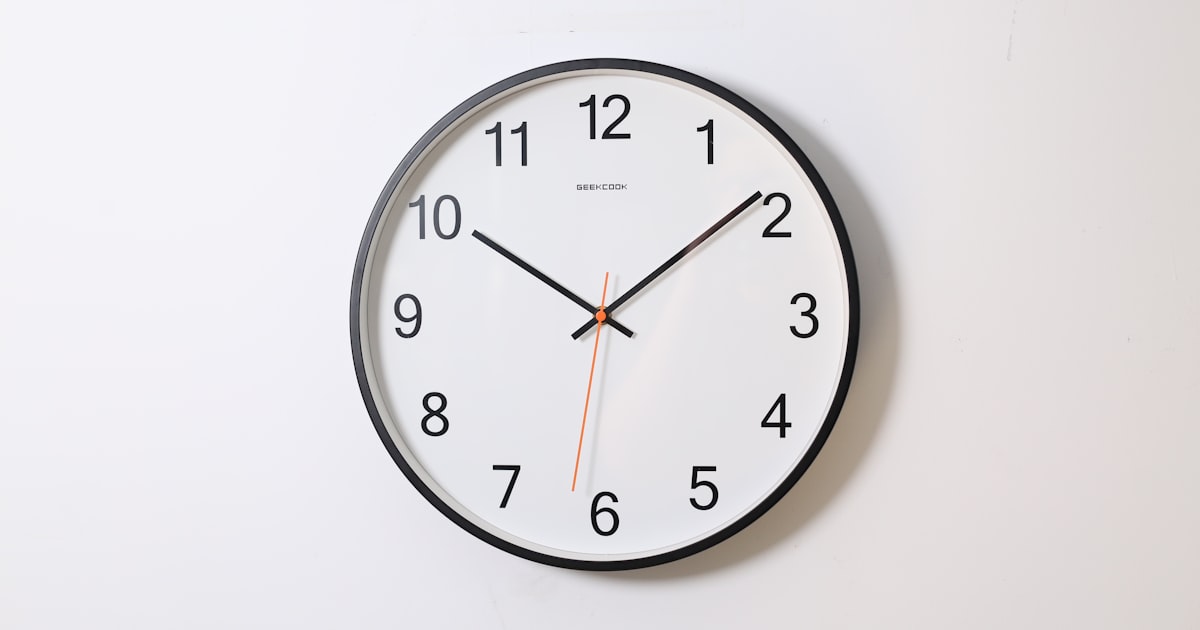
Two Clocks, One Body
You decided to become a morning person. New alarm, 6:00 AM. You've held the line for three weeks.
You still feel like garbage at 6:00 AM. You're still wide awake at 11:30 PM. Nothing has moved except your alarm.
That's not a discipline failure. It's what happens when you change your schedule without changing your clock. Those are two different things, and most sleep advice mashes them into one word — "routine" — which is why so much of it quietly doesn't work.
This post is educational, not medical advice. If your timing problem is bad enough to wreck your job or your mood, that's a conversation for a doctor.
Key Facts
- Your body clock lives in the suprachiasmatic nucleus, a small region of the hypothalamus, and light reaching the retina is what sets it (StatPearls)
- The melatonin rhythm is "the most commonly used circadian phase marker in humans," measured in dim light under 30 lux with samples every 30 to 60 minutes (Journal of Clinical Sleep Medicine, 2008)
- A single bright light pulse shifted people's clocks by up to 3.60 hours later or 2.01 hours earlier, depending entirely on when it hit (The Journal of Physiology, 2003)
- Melatonin's direction depends on timing too: afternoon or evening advances the clock, morning delays it (JCEM, 2010)
- About two-thirds of the studying and working population in industrialized countries lives with social jetlag (Nutrients, 2021)
- Estimating your clock from a wearable is unsolved. A 2026 preprint (not peer reviewed) got within about 1.19 hours using light and activity data from 14 people (arXiv preprint)
What "Circadian Phase" Actually Means
Start with the hardware. There's a cluster of cells in your hypothalamus called the suprachiasmatic nucleus — the SCN, if you want the acronym. It's the master timekeeper. Signals from light-sensing cells in your retina travel up the optic nerve and reach it, which is how the outside world tells your inside world what time it is [^1].
The SCN runs a roughly 24-hour program. Body temperature, alertness, hormone release, digestion — all of it rides on that program.
"Circadian phase" is just the position of that program right now. Think of a record spinning. Phase is which part of the groove the needle is currently on.
Here's the part people miss. Phase is not your bedtime. Phase is not your alarm. Phase is a physical state inside your body, and you cannot read it off a clock on the wall.
How Scientists Find Your Real Clock Position
If phase is invisible, how does anyone measure it?
The standard method is dim light melatonin onset, usually shortened to DLMO. Melatonin is the hormone your body starts releasing in the evening as your internal night begins. The moment it starts rising is a reliable marker of where your clock is sitting.
The catch is that bright light suppresses melatonin. So you have to measure it in the dark — a 2008 consensus paper on melatonin measurement says collection "in dim light of less than 30 lux is considered acceptable for most purposes," with some researchers preferring under 10 lux, and saliva samples taken every 30 to 60 minutes across the evening [^2]. That same paper calls the melatonin rhythm "the most commonly used circadian phase marker in humans" [^2].
Read that again. To find out what time it is inside you, you sit in near-darkness for hours spitting into tubes on a schedule. That's the actual measurement.
Everything else — chronotype quizzes, "are you a night owl" questions, your tracker's bedtime graph — is a proxy. Some proxies are decent. None of them are the thing.
Why You Can Force A Schedule Your Clock Hasn't Moved To
Now the mismatch.
You can absolutely make yourself get out of bed at 6:00 AM. Alarms work. Coffee works for a while.
What you can't do by decision alone is move the SCN. If your internal night runs from 1:00 AM to 9:00 AM and your alarm goes off at 6:00, you're waking up in the middle of your biological night, every single day. That's not a metaphor. Your temperature is still near its low point. Your melatonin hasn't finished clearing.
That feeling — awake but wrong, for hours — is the same physiology as jet lag. The difference is that jet lag ends. This doesn't, because you didn't fly anywhere. Your clock stayed put and your calendar moved.
Researchers named this social jetlag: the difference between when you sleep on free days and when you sleep on obligated days [^3]. It's measured as the gap between the midpoint of your sleep on free days and the midpoint on work days.
It's not rare. A 2021 review reports that in industrialized countries about two-thirds of the studying and working population has social jetlag, and that "70% of students and workers experience at least one hour," with almost half experiencing two hours or more [^3]. That review links social jetlag to poorer sleep, metabolic changes, and mood symptoms — as associations, not proven causes. Keep that straight.
We've written separately about what weekend catch-up sleep does and doesn't fix.
What Actually Moves The Clock
Here's the good news: the clock does move. It just responds to specific inputs, in specific directions, at specific times.
The landmark experiment is a 2003 study that gave 21 people a single bright light pulse at different points in their circadian cycle and measured the shift. The results form what's called a phase response curve — a map of "light at this time does this." The peak delay was −3.60 hours and the peak advance was +2.01 hours, a total swing of about five hours depending purely on timing 1.
The rule that falls out of it is simple and worth memorizing:
- Light before your body temperature bottoms out (late evening, middle of the night) pushes your clock later.
- Light after that low point (early morning) pulls your clock earlier.
Melatonin as a supplement works on a similar timing logic, in roughly the opposite direction. A 2010 review of the melatonin phase response curve puts it plainly: "when given in the afternoon/evening it causes phase advances," and "when given in the morning, melatonin causes phase delays" 2. Timing relative to your own DLMO — not clock time, not "bedtime" — is what determines the direction.
Which means a lot of people taking melatonin at the wrong hour are pushing their clock the wrong way. More on that in melatonin dose and timing.
| Thing you do | Moves your clock? | What it actually does |
|---|---|---|
| Bright morning light | Yes, earlier | Advance, per the light phase response curve 1 |
| Bright light late at night | Yes, later | Delay — usually the opposite of what you want 1 |
| Melatonin in the afternoon/evening | Yes, earlier | Advance, timing relative to DLMO 2 |
| Melatonin at wake time | Yes, later | Delay 2 |
| Setting an earlier alarm | No | Cuts sleep short, clock unchanged |
| Going to bed earlier by decision | No | You lie there awake |
| Sleeping in on Saturday | Indirectly, later | Changes light timing, widens social jetlag 3 |
| Blackout curtains alone | No | Removes a signal; doesn't supply the morning one |
Notice the pattern. Almost everything that moves the clock is a light or hormone signal at a particular time. Almost everything that doesn't is a decision about your calendar. More on the practical light side in light exposure and your body clock.
So Can A Wearable Just Tell You Your Phase?
This is where the field currently is, and the honest answer is: not yet, not reliably.
A 2026 preprint — not peer reviewed — tried to estimate circadian phase in real time from short windows of wearable data, using core body temperature rhythm as the reference. With 14 participants in a free-living study, using only light exposure and physical activity, the model landed within a mean error of about 1.19 hours. Accuracy improved with longer data windows but flattened out around eight hours of history 4.
Fourteen people. Roughly an hour of error. A promising research result, not a shipping feature.
There's a deeper problem too. Even the researchers who coined "social jetlag" have pushed back on their own proxy. In a 2019 self-critical review, they note that "it is virtually impossible to directly assess an individual's phase of entrainment," and that the circadian system "does not remain in the same state throughout the week but changes with the shifting sleep times" 5. Your free-day sleep midpoint isn't a fixed true north. It moves too.
So when a device shows you a "circadian rhythm" graph, understand what it is: an estimate built from movement and light, not a measurement of your clock.
The Practical Version
Strip out the science and you get four things worth doing:
- Stop treating your alarm as your clock. Changing when you get up doesn't change when your body thinks it's night.
- Move phase with light, on purpose. Morning light to shift earlier. Dim evenings to stop shifting later.
- Move in small steps. Fifteen to twenty minutes at a time, held for several days, beats a two-hour jump you abandon by Wednesday. Consistency does the work — we made that case in body clock habits, not heroics.
- Watch the weekend gap. If your free-day sleep midpoint is two hours later than your workday one, that's the size of the mismatch you're fighting every Monday.
Where Komori Fits
Komori can't tell you your circadian phase. Nothing on your wrist or above your bed can — phase is a hormone measurement, and these are motion and environment sensors. Anyone claiming otherwise is selling an estimate dressed as a fact.
What it's being built to do is narrower. When it ships, Komori is designed to log sleep position, movement and restlessness, bed-exit events, and room conditions like temperature, humidity, CO2, light and noise — contactless, no camera, nothing worn. It's a general wellness device. It doesn't diagnose anything.
The useful part here is consistency data across many nights: when you actually settled, when you actually got up, and how much light your bedroom had. That won't give you a phase number. It will show you whether the schedule you think you keep is the schedule you keep — and that gap is usually the first thing worth fixing.
The Bottom Line
Your schedule is a decision. Your clock is a biological state. You can change the first one tonight and the second one only slowly, with light, in the right direction, at the right time.
If you've been calling yourself lazy for not adapting to a schedule your body hasn't moved to, stop. That's not a character problem.
And if the mismatch is bad enough that you can't hold a job or a class schedule, there are real clinical circadian disorders with real treatments. Bring it to your doctor. That beats another year of blaming yourself.
Footnotes
-
Khalsa SBS, Jewett ME, Cajochen C, Czeisler CA. "A phase response curve to single bright light pulses in human subjects." The Journal of Physiology, 2003;549:945-952. ↩ ↩2 ↩3
-
Lewy AJ. "Clinical Implications of the Melatonin Phase Response Curve." The Journal of Clinical Endocrinology and Metabolism, 2010;95(7):3158-3160. ↩ ↩2 ↩3
-
Caliandro R, et al. "Social Jetlag and Related Risks for Human Health: A Timely Review." Nutrients, 2021;13(12):4543. ↩
-
Xu M, Cabrilo N, van Gilst M, Linnartz JP. "Toward Real-Time Circadian Phase Estimation with Low Latency from Wearable Sensing Data." arXiv preprint 2605.00910, 2026. Preprint — not peer reviewed. ↩
-
Roenneberg T, Pilz LK, Zerbini G, Winnebeck EC. "Chronotype and Social Jetlag: A (Self-) Critical Review." Biology, 2019;8(3):54. ↩
You can choose a position at lights-out. Knowing what you held until morning is the hard part.
Komori is a contactless monitor that logs which position you slept in, through blankets, with no camera and nothing to wear. Pre-launch — join the list and we'll tell you when it ships.
Keep reading


Want to see your sleep position data?
Join the free waitlist for launch updates. Or lock in founder pricing with the Insider Pass ($49, credited toward your purchase).