Why One Sensor Is Never Enough
Dovy Paukstys
Founder, Komori Care
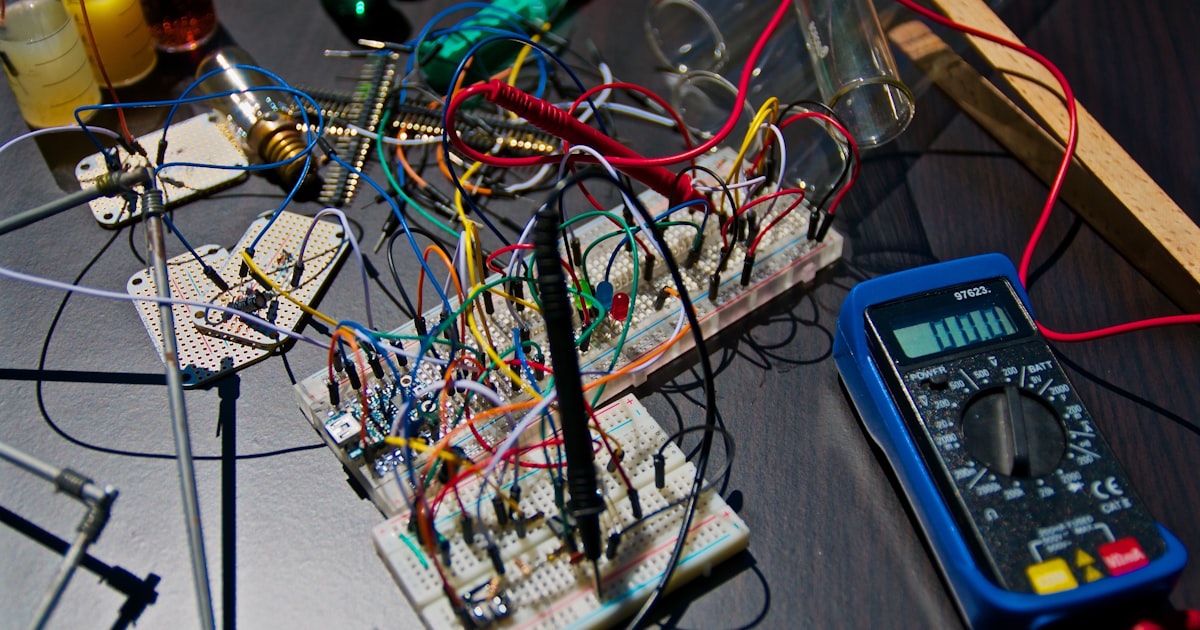
Every Sensor Is Confidently Wrong About Something
Point a radar at a bed and it will tell you, with great precision, that something in that bed moved four inches to the left. It will not tell you whether that was a person rolling over, a dog jumping up, or a ceiling fan wobbling in the beam.
Put a microphone in the room and it will hear a cough. It won't know which of the two people in the bed coughed.
Stick a temperature probe on the wall and it will report 71°F with real accuracy. It has no idea whether the person under the duvet is roasting.
This is not a story about bad sensors. Those are all correct measurements. The problem is that every sensor answers exactly one question and stays silent on everything else. Engineers call the fix sensor fusion, and the popular explanation of it — "more data is better" — gets the point almost exactly backwards.
Fusion isn't about volume. It's about coverage. One sensor's blind spot has to be another sensor's clear view, or you've just added noise.
Key Facts
- Fusing multiple sensors improves the reliability, accuracy, and resilience of health monitoring — a 2024 preprint reviewing the field (John et al., arXiv preprint)
- A systematic review of 54 contactless sleep-monitoring studies found radar in 38.5%, cameras in 30.8%, motion-based sensing in 13.5%, acoustics in 9.6%, thermal in 7.7% (Boiko et al., Sensors 2023)
- Radar accuracy depends on distance and obstacles; cameras break on lighting changes and motion (Boiko et al., Sensors 2023)
- Most of those systems were validated in controlled labs, not real bedrooms (Boiko et al., Sensors 2023)
- Blood oxygen requires light passing through pulsing tissue at 660 and 940 nanometers (StatPearls, Pulse Oximetry)
- Sleep staging requires brain, eye, and chin muscle signals — EEG, EOG, and EMG (StatPearls, Sleep Study)
Want a follow-up on this topic? Get a note when Komori launches (2027)
One email when the contactless monitor ships, plus the occasional short follow-up on this topic. No spam, leave any time.
What Each Sensor Actually Sees
Before you can combine sensors sensibly, you have to be honest about what each one measures and where it goes blind. Here's the map for the modalities that show up in contactless in-room sensing.
| Sensor | What it sees well | Where it goes blind |
|---|---|---|
| Radar | Movement, position, distance, body outline | Why the movement happened; who moved; degrades with distance and obstacles 1 |
| Microphone | Sound events — coughs, snores, a door, a cry | Which person made the sound; whether anyone is even in the bed |
| Temperature sensor | Room air temperature | What the person under the covers feels |
| Humidity sensor | Moisture in the air | Whether that humidity matters to this sleeper |
| CO2 sensor | Air quality and rough occupancy | Nothing about the person specifically |
| Ambient light sensor | Room brightness over time | Whether light is reaching a closed eyelid |
| Camera | Almost everything visually | Nothing in the dark without IR; hard fails on lighting and motion; and it's a camera in your bedroom 1 |
Read down the right-hand column. Every one of those blind spots is real and permanent for that sensor. No firmware update fixes physics.
Redundancy vs Disambiguation
Fusion does two distinct jobs, and people mix them up constantly.
Redundancy is when two sensors can answer the same question, so one covers the other's failure. If radar loses the target because someone piled laundry in the beam path, an acoustic channel can still tell you the room isn't empty. Neither sensor is better. They fail in different situations, which is the entire point.
Disambiguation is more interesting. It's when two signals that are individually ambiguous become unambiguous together.
Consider three of those signals: movement, sound, and bed presence.
- Movement + snoring + still in bed → almost certainly restless sleep
- Movement + no sound + bed exit → someone got up
- No movement + no sound + no bed presence → the bed is empty and has been for a while
- Movement + a loud sound in the room + no bed exit → something happened in the environment, not to the sleeper
Not one of those conclusions is available from a single channel. Movement alone is the same number in all four cases. The information lives in the combination, not in any one sensor.
The published review literature says the same thing in drier language: integrating data from multiple sources improves the reliability, accuracy, and resilience of health monitoring systems, though it introduces its own problems around data quality and differences between acquisition systems 2. That's from a 2024 review paper — a preprint, not yet peer reviewed — that catalogs the fusion algorithms people actually use, including Kalman filters, Bayesian networks, and machine-learning models 2.
The Failure Modes Are Where the Design Happens
A systematic review in Sensors went through 54 peer-reviewed studies of contactless sleep monitoring published between 2017 and 2022 1. It's the best available inventory of what works and what breaks.
The distribution of approaches 1:
- Radar (Doppler, ultra-wideband, continuous wave): 38.5% of studies
- Camera-based imaging (RGB, infrared, depth, phone cameras): 30.8%
- Motion detection via accelerometers and similar: 13.5%
- Acoustic analysis: 9.6%
- Thermal imaging: 7.7%
And the limitations, which are the useful part 1:
- Radar accuracy "depends heavily on device-to-patient distance and obstacle interference"
- Camera approaches are "susceptible to lighting variations and motion artifacts" and carry obvious privacy problems
- Motion-based sensing accuracy is affected by sensor placement and vibration
- And the big one: most of these systems were "validated in controlled environments rather than realistic clinical or home settings"
That last line is the honest verdict on the whole field. A sensor that works beautifully in a lab, at a fixed distance, with a cooperative subject and no clutter, is not the same sensor working above a real bed with two people, a comforter, and a cat.
Which is exactly why you don't build a product on one. You pick sensors whose failure conditions don't overlap. Radar degrades with obstacles. Sound doesn't care about obstacles. Environmental sensors don't care about either. Stack those and the system keeps producing something useful when any one channel gets confused.
We went deep on the radar half of this in the engineering behind 60 GHz radar and sleep position, including why the placement of the sensor changes what it can resolve.
What Fusion Does Not Fix
Here's where most sensor-fusion marketing goes off the rails, so let's be blunt.
Fusion cannot manufacture a signal that none of the sensors can see. Combining ten sources of information about movement gives you a very good picture of movement. It gives you exactly zero information about anything none of them measures.
Two concrete examples.
Blood oxygen. Pulse oximetry works by shining light at two wavelengths — 660 nm and 940 nm — through tissue, because oxygenated and deoxygenated hemoglobin absorb those wavelengths differently. The device needs to detect actual arterial pulsations in a capillary bed, with an emitter and detector positioned on or around that tissue 3. That's an optical measurement requiring contact with a perfused body part. No amount of radar, audio, or thermal data in the room adds up to it. There's no clever algorithm here. The photons aren't there.
Sleep stages. Clinical sleep staging is based on EEG (brain waves), EOG (eye movements), and submental EMG (chin muscle tone), scored in 30-second epochs 4. Those signals come from electrodes on the scalp, around the eyes, and under the chin. A contactless sensor across the room is not measuring cortical electrical activity. It can measure things that correlate with sleep stages — movement, stillness, timing — and that correlation is real and useful. It is not the same measurement, and anyone who tells you otherwise is selling something. We took that argument apart in how accurate wearable sleep stages actually are.
So the honest rule for any fused system: fusion multiplies the value of signals you have. It does not create signals you don't.
The Cost of Adding Sensors
Fusion isn't free, either, and pretending it is leads to bloated products.
Every sensor you add brings power draw, heat, cost, a calibration burden, a failure mode, and a data stream someone has to store and protect. The review literature flags exactly this — data quality problems and mismatches between acquisition systems are named as core open challenges in fusion 2.
The discipline is to add a sensor only when it covers a specific blind spot you've identified in the sensors you already have. Not because the spec sheet looks better with another line on it.
Where Komori Fits
Komori is being built as a two-piece system for exactly the reasons above. A small sensor mounts above the bed — that's where the sensing happens, looking down at the sleep surface — and a base unit sits on the nightstand handling power, Wi-Fi, and local processing. Contactless. No camera. Nothing worn.
The sensing set it's being designed around is deliberately scoped: sleep position, movement and restlessness, bed-exit events, sound events, and the room environment — temperature, humidity, CO2, light, and noise. Each of those was chosen because it covers something the others can't. Position and movement come from above, where the geometry is cleanest. Sound catches events that produce no movement. Environment explains conditions that neither of the others can see.
And the things it will not do, we say out loud: Komori does not measure breathing, respiration, heart rate, heart rate variability, or blood oxygen. It doesn't do sleep staging in the clinical sense. It's a general wellness device with no FDA clearance, it diagnoses nothing, and it detects no medical condition. Those aren't limitations we're working around quietly. They're the boundary, and we keep a standing list of what Komori cannot do.
We chose the placement and the sensor mix knowing exactly what each part goes blind to. That's the whole job.
The Rule Worth Keeping
When you're evaluating any monitoring product, contactless or otherwise, ask two questions.
One: what does each sensor go blind to, and what covers that gap? If the answer is "nothing, we just have a really good radar," the system will fail in ways you'll discover at 3 a.m.
Two: is this measurement physically available to these sensors at all? If a product claims something that requires contact, light through tissue, or electrodes on a scalp, and it has none of those, the claim isn't ambitious. It's false.
Good engineering is mostly knowing what you can't see, and building around it on purpose.
Footnotes
-
Boiko A, Martínez Madrid N, Seepold R. "Contactless Technologies, Sensors, and Systems for Cardiac and Respiratory Measurement during Sleep: A Systematic Review." Sensors (Basel), 2023. Systematic review of 54 studies published 2017–2022. ↩ ↩2 ↩3 ↩4 ↩5
-
John A, Cardiff B, John D. "A Review on Multisensor Data Fusion for Wearable Health Monitoring." arXiv preprint 2412.05895, 2024. Preprint — not yet peer reviewed. ↩ ↩2 ↩3
-
Torp KD, Modi P, Pollard EJ, Simon LV. "Pulse Oximetry." StatPearls Publishing, 2026. ↩
-
Sankari A, Slowik JM. "Sleep Study." StatPearls Publishing, 2026. ↩
Want a follow-up on this topic? Get a note when Komori launches (2027)
One email when the contactless monitor ships, plus the occasional short follow-up on this topic. No spam, leave any time.
Keep reading

Want to see your sleep position data?
Join the free waitlist for launch updates. Or lock in founder pricing with the Insider Pass ($49, credited toward your purchase).