Blue-Light Glasses: Does the Evidence Hold Up?
Dovy Paukstys
Founder, Komori Care
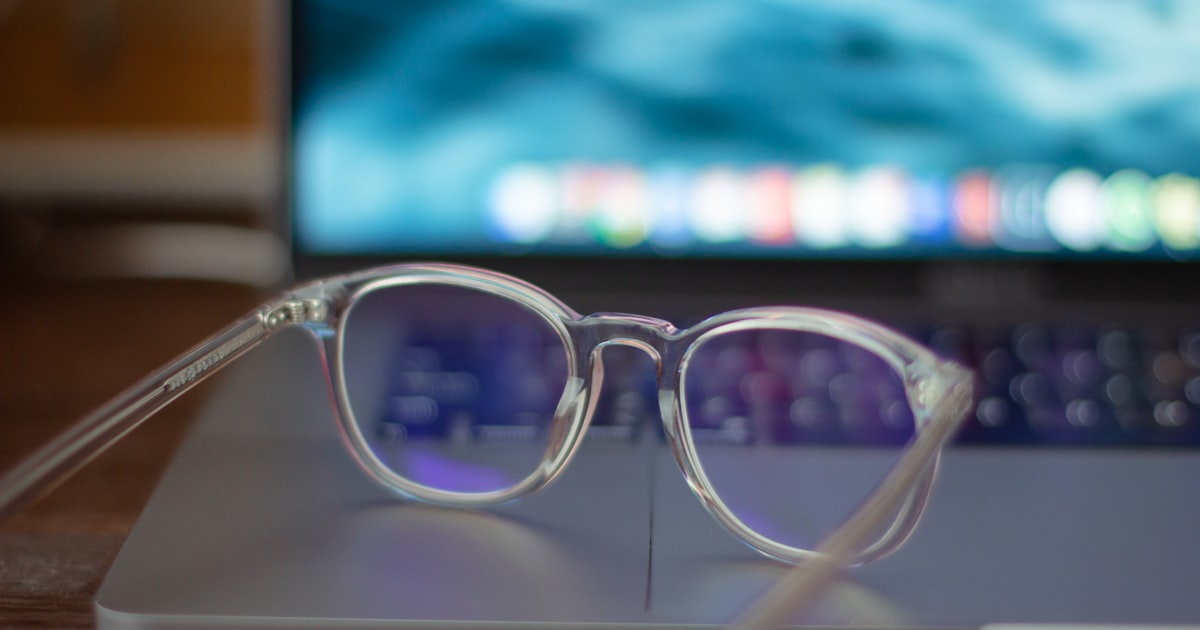
A Billion-Dollar Product Built on a Real Mechanism
Walk into any optician and someone will offer to add a blue-light filter to your lenses for a fee. Amazon sells thousands of "computer glasses." The pitch is always the same two promises: your eyes will hurt less, and you'll sleep better.
One of those rests on solid biology that got stretched. The other rests on almost nothing.
My position up front, then I'll show the work. The mechanism behind blue light and sleep is real and well studied. The consumer product built on top of it has thin, low-quality evidence, and the eye-strain claim is weaker still. Amber-tinted glasses worn at night have somewhat better support than the faintly yellow "computer glasses" people wear all day, but even that evidence is small and shaky.
None of that makes them a scam. It makes them oversold. That's a different thing, and the distinction matters if you're deciding whether to spend the money.
Key Facts
- The mechanism is real: the eye's circadian light sensors peak near 480 nm, in the blue part of the spectrum (Journal of Physiological Anthropology, 2018)
- Ordinary room light suppresses melatonin badly: under 200 lux cut melatonin by 71.4% versus dim light in 116 people (JCEM, 2011)
- Cochrane reviewed 17 trials and 619 people and found blue-light filtering lenses may not reduce eye strain, on low-certainty evidence (Cochrane, 2023)
- Sleep evidence was rated very low certainty — three trials showed improvement, three showed none (Cochrane, 2023)
- A 2025 meta-analysis of 3 crossover trials (49 people) found no significant effect on any measured sleep outcome (Frontiers in Neurology, 2025)
- Morning bright light does shift the clock: 2.5 hours of ~6000 lux advanced circadian timing by 1.0 hour in teens (Frontiers in Neuroscience, 2020)
The Mechanism Is Real. Start There.
Your eye does two jobs. It sees, and it tells your body what time it is.
The time-telling job runs through a separate set of cells in the retina that aren't rods or cones. They contain a pigment called melanopsin, and their peak sensitivity sits at roughly 480 nm — blue light [^1]. When those cells fire in the evening, your brain holds back melatonin, the hormone that rises at night and signals sleep is coming.
So the chain is: blue-ish light at night, cells fire, melatonin suppressed, sleep pushed later. That part is not controversial. It's been replicated for two decades.
And light at night suppresses melatonin more than most people would guess. In a study of 116 healthy adults, exposure to ordinary room light — under 200 lux — cut melatonin by 71.4% compared with dim light, and shortened the window of melatonin production by about 90 minutes [^2]. Two hundred lux is not a stadium floodlight. It's a normally lit living room.
That's the biology. It says light at night is a real problem. It does not say that a tinted lens solves it.
The Product Claim Is a Different Claim
Here's the leap that gets skipped. "Blue wavelengths suppress melatonin most" is a statement about photons. "Wearing these glasses will improve your sleep" is a statement about a consumer product used by real people in real evenings.
You have to test the second one directly. And when people did, the results got much less impressive.
The best summary is the 2023 Cochrane review, which is about as rigorous as evidence synthesis gets. It pulled together 17 randomized controlled trials with 619 participants across six countries and asked three questions: do blue-light filtering lenses reduce eye strain, do they help sleep, and do they protect the retina [^3].
The answers:
Eye strain: probably not. The review concluded these lenses "may not attenuate symptoms of eye strain with computer use, over a short-term follow-up period" compared with ordinary lenses. Certainty of evidence: low [^3].
Sleep: unclear, and the evidence is bad. Three trials showed improvement, three showed no difference. Certainty: very low [^3]. "Very low certainty" is Cochrane's polite way of saying the studies were too small and too inconsistent to conclude anything.
Retinal protection: no evidence at all. Not "no effect" — literally no studies examined it, so the review could draw no conclusions [^3].
A 2025 meta-analysis in Frontiers in Neurology took a narrower slice: three randomized crossover trials with 49 participants total, measuring sleep by actigraphy, which is a wrist motion sensor that estimates sleep. Nothing reached significance. Time to fall asleep changed by −4.86 minutes (95% confidence interval −20.23 to +10.52). Total sleep time, +8.75 minutes. Sleep efficiency, −0.61 percentage points [^4]. All of those confidence intervals sit comfortably across zero, which is the statistical way of saying "we can't tell this apart from nothing."
Forty-nine people, three studies. That is the state of the art.
Eye Strain and Sleep Are Separate Claims, and Both Are Weak
These get blurred constantly in marketing, so let's separate them.
The sleep claim is at least mechanistically plausible: block the wavelengths that suppress melatonin, get more melatonin. The evidence just hasn't confirmed it in practice.
The eye-strain claim never had a strong mechanism in the first place. Digital eye strain comes from how you use a screen, not from its color temperature. The American Optometric Association lists the causes as poor lighting, glare on the screen, improper viewing distance, poor seating posture, and uncorrected vision problems — the visual demands of the task exceeding what your eyes comfortably manage [^5]. (The AOA does say blue light from screens and LED lighting can affect vision long term and mentions lens tints as an option, so this isn't a case of optometrists universally dismissing them.)
Notice what dominates that list: ergonomics and uncorrected prescriptions. If your eyes ache after six hours of spreadsheets, the highest-yield fixes are the boring ones. The AOA's advice is the 20-20-20 rule — every 20 minutes, look at something 20 feet away for 20 seconds — plus deliberate blinking, screens positioned 15 to 20 degrees below eye level at 20 to 28 inches, and glare control [^5]. Free. Boring. Better supported.
Where the Evidence Is Slightly Better
I said I'd be fair, so here's the strongest case for the product.
There's a real difference between deeply amber lenses worn in the couple of hours before bed and lightly tinted "computer glasses" worn all day. The amber ones block far more short-wavelength light. They also make everything look like a sepia photograph, which is why nobody wears them to the office.
A 2020 systematic review and meta-analysis in SLEEP Advances looked at 12 studies of interventions to cut short-wavelength light at night — mostly glasses — and found small-to-medium improvements in sleep efficiency (Hedge's g = 0.31) and total sleep time (g = 0.32), with a much larger effect on self-reported sleep quality on the Pittsburgh Sleep Quality Index (g = −1.25) 1.
That looks encouraging until you read the caveats, which the authors state plainly. The studies averaged 6 to 21 participants each. Methods varied wildly. Lens specifications varied. Most studies didn't even measure melatonin, despite melatonin being the proposed mechanism. Risk of bias was a problem across the board 1.
And the gap between the huge subjective effect and the modest objective one is a familiar pattern. You cannot blind someone to whether they're wearing orange glasses. They know they're doing a sleep intervention, so they rate their sleep better. That's not fraud, it's just how expectation works — and it's exactly why the objective numbers matter more.
Fair verdict: amber lenses in the last hour or two before bed have somewhat better support than clear or faintly tinted computer glasses, which have close to none. If you're going to buy a pair, buy that kind and wear them at that time.
The Claims, Scored
| The claim | What the evidence says | My verdict |
|---|---|---|
| Blue light suppresses melatonin | Well established; circadian sensors peak near 480 nm 2 | True |
| Evening light delays your body clock | Well established; even 200 lux room light cuts melatonin 71% 3 | True |
| Blue-light glasses reduce eye strain | 17 trials, 619 people, low certainty, probably no effect 4 | Not supported |
| Blue-light glasses improve sleep | Very low certainty; a 3-trial, 49-person meta-analysis found nothing significant 4 5 | Not supported |
| Amber lenses before bed help a little | Small-to-medium objective effects, but tiny studies with bias risk 1 | Weak, possible |
| They protect your retina | Zero studies. Not "no effect" — no data at all 4 | Unknown, unclaimed |
| Dimming lights at night helps | Direct evidence on melatonin from a 116-person study 3 | True |
| Morning bright light shifts your clock | 2.5 h at ~6000 lux advanced timing by 1.0 h in teens 6 | True |
What Actually Works Better
If your real goal is falling asleep at a reasonable hour, the lens tint is the least powerful lever you can pull. Three better ones:
Turn the lights down, not just blue-er. Intensity is doing enormous work here. Room light at under 200 lux suppressed melatonin by 71% 3, and no lens filters intensity the way a dimmer switch does. Lamps instead of overheads, lower brightness on every screen, and fewer lit rooms in the last hour. Our bedroom setup guide covers the rest of the environment.
Get real light in the morning. This is the underrated half of the equation. Morning light pulls your body clock earlier, which is what actually moves your bedtime. In 37 adolescents with late bedtimes, 2.5 hours of roughly 6000 lux on two weekend mornings advanced circadian timing by 1.0 hour, significantly more than room light alone 6. Outdoor light on an overcast day beats anything in your house by an order of magnitude. Go outside.
Keep the timing consistent. A stable schedule does more for how fast you fall asleep than any accessory. If you want the detail on that, we wrote about how long it should take to fall asleep.
Should You Buy Them?
If you already own a pair and like them, keep wearing them. Adverse effects in the trials were infrequent, and a nightly ritual that signals "the day is over" has value even when the lens does nothing.
If you're deciding whether to spend money: buy the dimmer switch first, and go outside in the morning. If you still want glasses after that, get properly amber ones for the hour before bed rather than a clear-lens upsell at the optician's counter.
What I'd push back on is treating them as the fix. People buy the glasses, keep every light in the house blazing until midnight, and wonder why nothing changed. The glasses were never the strong lever.
Where Komori Fits
Light is one of the things Komori is being designed to measure. Not through a camera — there isn't one — but as part of the room environment channel, alongside temperature, humidity, CO2, and noise.
The reason it's on the list is the argument in this post. Most people have no idea how bright their bedroom is at 11pm, or that the hallway light bleeding under the door is doing more than their screen. When it ships, Komori is meant to log that night after night, so the picture you work from is measured rather than remembered.
It's a wellness device, not a diagnostic one, and it won't tell you whether your glasses are working. It's meant to tell you what your room was doing while you slept. We're allergic to compressing that into a single number, which is why we won't be shipping a sleep score.
The Bottom Line
The science of blue light is good. The product built on it isn't well supported, and the eye-strain claim in particular has been repeated far past what the evidence carries.
Dim your house. Go outside in the morning. Keep a consistent schedule. If you want amber glasses on top of that, fine — just buy them knowing what you're buying: a plausible small effect and a decent bedtime ritual, not a solved problem.
Footnotes
-
Shechter A, Quispe KA, Mizhquiri Barbecho JS, Slater C, Falzon L. "Interventions to reduce short-wavelength ('blue') light exposure at night and their effects on sleep: A systematic review and meta-analysis." SLEEP Advances, 2020. ↩ ↩2 ↩3
-
Kozaki T, Hidaka Y, Takakura J, Kusano Y. "Suppression of salivary melatonin secretion under 100-Hz flickering and non-flickering blue light." Journal of Physiological Anthropology, 2018. ↩
-
Gooley JJ, et al. "Exposure to Room Light before Bedtime Suppresses Melatonin Onset and Shortens Melatonin Duration in Humans." The Journal of Clinical Endocrinology & Metabolism, 2011. ↩ ↩2 ↩3
-
Singh S, Keller PR, Busija L, McMillan P, Makrai E, Lawrenson JG, Hull CC, Downie LE. "Blue-light filtering spectacle lenses for visual performance, macular protection, and improving sleep quality." Cochrane Database of Systematic Reviews, 2023. ↩ ↩2 ↩3
-
Luna-Rangel FA, et al. "Efficacy of blue-light blocking glasses on actigraphic sleep outcomes: a systematic review and meta-analysis of randomized controlled crossover trials." Frontiers in Neurology, 2025. ↩
-
Misiunaite I, Eastman CI, Crowley SJ. "Circadian Phase Advances in Response to Weekend Morning Light in Adolescents With Short Sleep and Late Bedtimes on School Nights." Frontiers in Neuroscience, 2020. ↩ ↩2
You can choose a position at lights-out. Knowing what you held until morning is the hard part.
Komori is a contactless monitor that logs which position you slept in, through blankets, with no camera and nothing to wear. Pre-launch — join the list and we'll tell you when it ships.
Keep reading
Want to see your sleep position data?
Join the free waitlist for launch updates. Or lock in founder pricing with the Insider Pass ($49, credited toward your purchase).